16:00 International News in DPRK Media (November 2, 2026) | |
November 2, Pyongyang (RSTV) [조선어] [English] [Русский] [中国语]
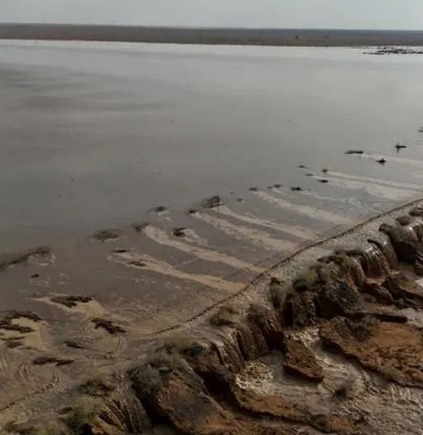
The sixth page of the November 2, 2026 issue of Rodong Sinmun carried an article introducing the state of Russia's economy and industry, which is developing stably even under Western sanctions; an article exposing Europe's nuclear confrontation ambitions that are intensifying regional instability; a warning over Britain's scheme to supply missiles to Ukraine; the remarks of a spokesman of the Chinese Ministry of National Defence condemning Japan's dangerous intentions; a rally in Tokyo, Japan, condemning the militarization policy; the situation of the spread of infectious diseases in various countries; and news of earthquakes, volcanic eruptions and natural damage in various places. Russia Developing Stably Even under Western Sanctions The West is viciously scheming to destroy the Russian economy. More than 30,000 sanctions have been imposed on Russia. This is twice as many as the sanctions imposed on all other countries of the world combined. The West is even applying sanctions to countries that trade with Russia. Yet the Russian economy is developing stably. At present the rate of economic growth of this country has surpassed the world average. In 2023–2025 Russia's gross domestic product (GDP) increased by 10.3 percent. All this is due to the staunch efforts of the Russian government and people to develop the economy by mobilizing all their own potential and possibilities and to defend the dignity and sovereignty of the country. In mid-October the 21st forum of the all-Russian public organization Delovaya Rossiya was held in Russia. Delovaya Rossiya is an organization that represents the interests of Russian enterprises and carries on the work of creating a favourable and competitive business environment and of coordinating investment activity in the regions concerned in cooperation with regional governments. In the 25 years since its founding it has united authoritative enterprises and greatly contributed to promoting economic development. As it was held at a time when Russia is carrying out plans to create a new investment environment and to revitalize various fields including production, transport and tourism, this forum drew the close attention of home and abroad. In a speech here President Putin said that the government will continue to support business and investment activity in the future as well, and that this forum is focused not on discussion but on producing results through joint efforts. He stressed that in difficult times such as the present, strong and competitive enterprises become the guarantee of a powerful and independent state, and that this has been verified by history. At a coordinating council meeting of the Russian government held a few days later, the issue of localizing the technology and equipment of the oil and gas industry was importantly discussed. Russia currently ranks first in the world in natural gas reserves and second in output. It also possesses abundant oil reserves. The Russian government intends to widely generalize the experience of localization achieved by some units in the oil and gas industry. Of 220 important items of equipment, 80 percent are at the stage of scientific research and trial assembly. Some of them have already established serial production processes. The government has set forth and is implementing the goal of localizing 90 percent of the technology in the energy sector by 2030. Recently the modern Rassvet satellite system was developed. Its performance is very excellent. Russia intends to launch satellites in the future as many as are needed. Russia also occupies a leading position in the field of nuclear power plant construction. Many Western countries talk a great deal about being ready to develop small nuclear power plants, but there is little progress. Russia, however, has already built a floating small nuclear power plant in the Arctic region and has been operating it since 2020. Russia is the only country that possesses such a plant at present. More than 20 technology development centres related to robotics, the chemical industry and the bioeconomy have been established. New vessels are being built, chemical industry enterprises are appearing, and the machine-building industry is expanding. All this underpins the country's long-term economic growth. The Far East and the Arctic region are developing greatly. In a series of major indicators the rate of development of these regions is surpassing the all-Russian rate of development. Russia intends not only to firmly hold the vast spaces of the Far East and the Arctic but also to further develop and strengthen the regions and build up the country's reliable and promising development potential. A strategy for the development of the Far East Federal District up to 2036 has already been drawn up, and the strategy for the development of the Arctic region and the ways of implementing it have been discussed. Despite serious challenges, Russia still occupies the position of a world economic power. This greatly displeases the West, which clings to futile sanctions schemes. Heo Yong Min, staff reporter Europe's Nuclear Confrontation Ambitions That Are Intensifying Regional Instability As Europe's nuclear confrontation intentions become ever more blatant, the danger that the region may turn into a arena of nuclear conflict is growing with each passing day. Not long ago the nuclear air forces of Britain and France conducted a joint exercise over the Mediterranean simulating a nuclear strike. It is said to have followed the agreement reached by the two sides in July last year to strengthen cooperation in the nuclear field. Britain and France, as the nuclear-weapon states of Europe, are the driving forces that continue to cling to the vain dream of inflicting a strategic defeat on Russia. This joint exercise is a blatant hint that they will not even shrink from the use of nuclear weapons in the confrontation with Russia. The British Defence Minister argued that "in an increasingly dangerous world we will together observe our commitments related to maintaining Europe's security and peace", but that is nothing more than wordplay to cover up dangerous nuclear confrontation ambitions. In step with Ukraine's defeat becoming evident, Europe is bringing out the nuclear confrontation card. In July Finland adopted a legislative amendment withdrawing the measure that had prohibited the introduction and deployment of nuclear weapons. Thereby Finland, following Poland, has come to be able to deploy the nuclear weapons of the US and France on its territory. In early October the parliament of Lithuania passed at the first reading a constitutional amendment deleting the provision prohibiting the deployment of weapons of mass destruction, including nuclear weapons. If the second reading is held in January next year, this provision, which has been maintained for over 30 years, will be finally abolished and the deployment of nuclear weapons by the nuclear powers on its territory will become possible. The trend related to France's nuclear forces is particularly dangerous. In March the president of this country, speaking of a "forward nuclear deterrence force", set forth a new nuclear strategy for expanding the operational sphere of the nuclear forces to the territories of other European countries and at the same time increasing the number of nuclear warheads. This has completely overturned the previous nuclear policy of gradually reducing the number of nuclear warheads while saying that nuclear forces would be used only for national defence. It was also publicly announced that the country's nuclear forces would be equipped with a new generation of nuclear-powered ballistic missile submarines. In early October a strategic ballistic missile that had entered combat deployment last year was test-launched from a nuclear-powered submarine. Regarding these nuclear confrontation moves that have entered the practical stage, many observers express serious concern that catastrophic consequences may be brought about. The Russian Foreign Minister sounded a warning that Europe's adventurous confrontation policy may in an instant spread into a situation accompanied by a nuclear strike and create a serious danger to global security. The secretary of the Russian Security Council stated that the successful test of the country's Sarmat intercontinental ballistic missile (ICBM) and the nuclear force use exercise would make Western strategists think coolly about the consequences of the confrontation policy. The Sarmat ICBM is one of the most powerful components of Russia's nuclear triad and a fifth-generation strategic weapon. The new Oreshnik hypersonic intermediate-range ballistic missile, which entered combat duty last year, is also very powerful. The development of the Poseidon nuclear-powered unmanned underwater vehicle and the Burevestnik nuclear-powered cruise missile is being pushed forward at the final stage. Futile nuclear blackmail or threats against Russia may bring about very serious consequences. At present there are no means of nuclear arms control, including documents, treaties or agreements capable of regulating the nuclear issue. In February this year the new strategic arms reduction treaty between Russia and the US expired. The "safety valves" installed to prevent collision between the nuclear powers—the treaty on the limitation of anti-ballistic missile systems, the treaty on the elimination of intermediate-range and shorter-range missiles and the treaty on open skies—have also already been dismantled. The Organization for Security and Co-operation in Europe (OSCE), which is supposed to coordinate Europe's security guarantees, peace and cooperation, has become nominal. In such a situation Europe's nuclear confrontation intentions are not any "deterrence" but may rather spark a real nuclear conflict that will bring enormous disaster to them as well. Jang Chol, staff reporter Warning over Britain's Scheme to Supply Missiles to Ukraine Maria Zakharova, spokeswoman of the Russian Foreign Ministry, condemned at a press conference on October 28 that Britain's attempt to again supply Storm Shadow missiles to Ukraine shows that this country seeks to aggravate the crisis. She warned that if British-made missiles are supplied to Ukraine, the relevant agencies of Russia will launch actions to eliminate them. She also mocked that the European Union, by thinking of recklessly plunging into a war with Russia, is pushing itself deeper into the noose of having to keep feeding the greedy Ukrainian authorities. [KCNA] Condemnation of Japan's Dangerous Intentions A spokesman of the Chinese Ministry of National Defence, at a press conference on October 29, sharply condemned and rejected the Japanese Defence Minister's argument that China, while possessing nuclear weapons and strategic bombers, is instead accusing Japan. He condemned that Japan is striving to evade its historical guilt, flouts international law, inverts black and white and obscures the truth. Saying that Japan's cunning excuses cannot cover up its dangerous intentions to strengthen military power, expand armed equipment and even possess and bring in nuclear weapons, he stressed that Japan must face its history of aggression squarely, reflect on it and thoroughly break with militarism. [KCNA] Rally Condemning the Authorities' Militarization Policy A rally condemning the authorities' militarization policy was held in front of the National Assembly building in Tokyo, Japan, on October 30. About 10,000 people took part in the rally. The participants protested that the militarization moves are becoming blatant, with Prime Minister Takaichi revealing an intention to possess nuclear submarines, and denounced that this is bringing about the result of heightening tension with the countries of the region. They stressed that at a time when the people's hardships in living are deepening owing to the rise in the cost of living in their country caused by the worldwide oil crisis, the authorities are instead clinging to war preparation schemes, and that this must never be tolerated. [KCNA] Situation of the Spread of Infectious Diseases - In Croatia, 25 people have been infected with the West Nile virus since the beginning of this year, and one of them has died, the country's health authorities announced on October 29. The number of infected persons has increased far more than last year, and the majority were confirmed after mid-July, it is said. - In Japan, during the one week up to October 25, the number of influenza patients reported from over 3,000 sentinel medical institutions nationwide reached 35,440. This is an increase of over 1,500 compared with the previous week, it is said. - African swine fever is spreading in Sri Lanka. According to what the country's authorities announced, it has been established that about 1,200 pigs at 48 farms in six regions including the capital were recently infected with the African swine fever virus. [KCNA] Earthquakes, Volcanoes and Natural Damage in Various Countries An earthquake measuring 6.4 on the Richter scale was observed southeast of Easter Island, Chile, on October 29. The depth of the epicentre was 10 km. On the same day an earthquake measuring 6 on the Richter scale occurred in Vanuatu. * * Mayon Volcano in Albay province, the Philippines, erupted on October 30. During the eruption, which lasted about six minutes, volcanic ash shot up to a height of 3,000 m from the crater. The country's institute of volcanology and seismology raised the volcanic alert to the highest level and designated a radius of 6 km from the volcano as a danger zone. * * In several provinces of Syria including Al-Raqqah and Deir ez-Zor, damage was caused by floods from heavy rain. As of October 29, five people had died and five were missing, and much farmland was submerged. Also, bridges and roads were destroyed and traffic was paralysed, it is said. [KCNA]
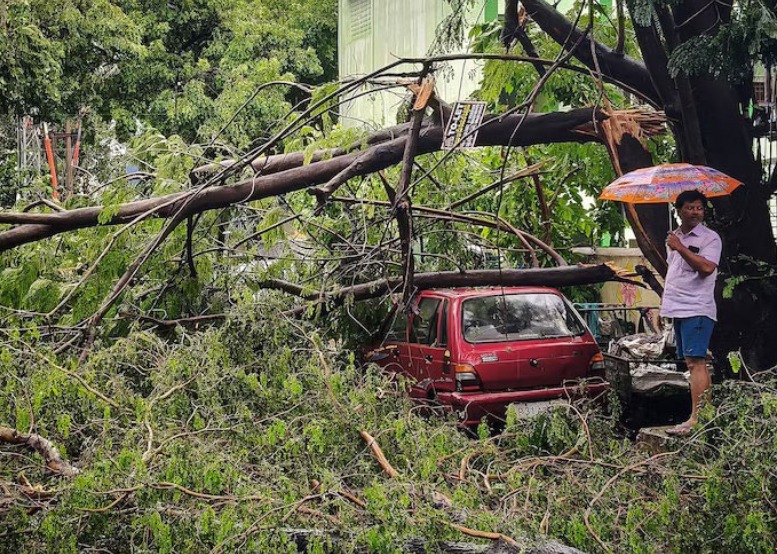
Damage from heavy rain and strong winds in India
Flood damage in Syria | |
| Category: English | Views: 30 | | | |