06:17 Looking at the Frontline Volunteer Applications, Oaths, Letters and Poems Left by the Defenders of the Fatherland in the 1950s | |
June 30, Pyongyang (Rodong Sinmun - RSTV)
[조선어] [English] [Русский] [中国语]
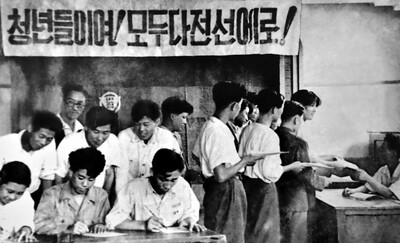
The past Fatherland Liberation War was an immensely great challenge to our newly founded fatherland and people. Yet this war, which the whole world assessed as a miracle of the 20th century, clearly showed the world that the aggressors had misjudged the Koreans and what kind of mental strength they possess. The heroes, known and unknown, who unhesitatingly offered themselves to counter the life‑and‑death crisis confronting the fatherland, displayed matchless self‑sacrifice and mass heroism, bringing about a great legendary victory that dealt defeat to the aggressors and astonished the world. Then what was the source of the intense spirit of defending the fatherland and the will to destroy the enemy that the defenders of the fatherland in the 1950s possessed? Reading the numerous frontline volunteer applications, oaths, letters and poems displayed at the Fatherland Liberation War Victory Memorial Hall, one can find the answer. The respected Comrade Kim Jong Un said as follows: “It was precisely because ordinary people from workplaces and schools confidently volunteered for the army and fought bravely against the US imperialist aggressor forces, for they had firm belief in their Party and their government, an unshakable conviction that we would surely win, and a strong will to defend their rights as masters of the new country and the new life.” At the Fatherland Liberation War Victory Memorial Hall, a considerable number of frontline volunteer applications from the 1950s are still preserved. Time has passed far since then, and the volunteer applications, written by ordinary workers, peasants, youth and students from every corner of this land over 70 years ago, have grown fluffy and faded. But reading their lines word by word, one can feel a single intense emotion permeating them. Never can it be taken away again! In these words lies the answer as to why the infinitely simple and ordinary people of this country took up arms and were able to display matchless self‑sacrifice and heroism unprecedented in the world history of war. In the volunteer application of Kim Ok Sun, a third‑year student of Cholwon Girls' Middle School in Kangwon Province in July 1950, it is written: “I write this letter at this unbearable moment when US imperialist aggressor planes have invaded the democratic school that our parents, under the wise leadership of General Kim Il Sung, built with blood and sweat over the past five years, and are carrying out barbaric bombings over our heads. I can no longer suppress my anger at the enemy's atrocities. … Please send me to the front. Please allow Ok Sun, who has been educated by the Leader and the Party, to go to the front….” What ideological feelings occupied the hearts of ordinary people who volunteered for the front can also be well understood by reading the writing left by Comrade Kang Sung Hyon, a hero of the Republic who fought to the death to defend the sky of the fatherland, when he left for the front. “I am now leaving for the front. I who, with liberation, came to understand the true meaning of fatherland and found true happiness together with the liberated fatherland—how could I hand over this precious fatherland again to the enemies!” Even in the letters that frontline warriors wrote word by word in the shell‑torn trenches that decided life and death, the feelings of fervent love for the land given by the Leader, their beloved homeland and their parents, wives and children flow palpably. Let us recall the content of the letter sent to his hometown by Comrade Han Pyong Gu, who covered the barbed wire with his own body to open the advance route for his unit and died a heroic death in the attack on Height 351 in June 1953. “To my beloved wife in the hometown. At this time when the five grains are ripening yellow and you are busy with the autumn harvest, I write a letter on the white paper you sent me and wish for your health in the hometown. How is this year's farming? Is our Jong Suk studying well? The small hand of Jong Suk that held my hand and smiled when I left home seems to convey to me a strong will even now….” The more you read, the more you can feel with a burning heart why the ordinary sons and daughters of this country took up arms, and where the roots of their death‑defying will and spirit of destroying the enemy lay. Though their ages, careers and occupations were different, the motive for volunteering for the front was the same for everyone: it was an eruption of the feeling of fervent love for my land, my factory, my home, my school given by General Kim Il Sung, and the soaring anger that all those precious things could never be taken away by the enemy again. In the short period of five years after liberation, the victorious generation keenly felt, in the joy of the new life they had enjoyed, how wretched colonial slavery was and how grateful the benevolence of the Leader and the benefits of the system were, which brought them true happiness and dignity. Precisely because their Leader and their system were so grateful to them, and the happiness and dignity they received in their embrace were so precious, ordinary workers, peasants, youth and students rose up all together for the sacred war of defending the fatherland wherever they were in this land. We well know about the sailors of the 2nd Torpedo Boat Squadron who created a miracle in world naval history by sinking a US imperialist heavy cruiser and damaging a light cruiser with four torpedo boats. Then how could they display matchless heroism, creating a miracle that astounded the world, by confronting an enemy superior in numbers and military technology? Reading the oath they addressed to the Supreme Commander before setting sail, one can well understand how intense their feelings of love and hatred were. “We clearly know that the sea of the fatherland is boundless, but there is not an inch of space for the US imperialist pirate ships to float. Our hearts gathered here are filled with the determination, as befits true soldiers of the Workers' Party of Korea and Korean youth who have inherited the noble will of the anti‑Japanese forebears, to fight bravely until the last moment of life and bury the US imperialist pirates deep in the sea….” Comrade Ro Tae Jin, a mortar battery commander of the 82mm mortar company, 1st Battalion, 4th Regiment, 2nd Infantry Division of the Korean People's Army, who remains in the history of the Fatherland Liberation War as a brave artillery hero, left this oath before battle: “…If my body is pierced by a villainous bullet and I fall in this battle, I will defend Height 1211 with my submachine gun, if even my submachine gun is broken, with a hand grenade, if even my hand grenade is gone, with my entrenching shovel, if even my shovel is broken, with my hands, if even my hands are gone, with my feet, if even my feet are gone, biting with my teeth—I swear this before the Party and the Leader.” Biting with my teeth! What a frost‑biting cry of hatred this is. He kept this oath and fired shells of destruction until the last moment of his breath. His comrades also shouted that they would firmly resolve once again to remain loyal to the great Leader and the fatherland until the last moment in the trenches of Height 1211—their homeland and their own courtyard—and waged the Ro Tae Jin Revenge Cannon Movement, raining a hail of fire upon the enemies. Thus, although the services and arms were different, the oath of the torpedo boat squadron and the resolution of Battery Commander Ro Tae Jin, which left legendary tales in the history of the Republic, clearly show that frost‑biting hatred against the enemy who tries to take away our precious things gives birth to heroism that defies even death. Here is a verse written in blood on a tree at the last moment by Comrade Ryang Hyong Ik, a reconnaissance platoon leader of the 13th Infantry Division of the Korean People's Army, during the battle of an unnamed height in front of Kachil Peak of Height 1211 in the Fatherland Liberation War. The fatherland, Oh mountains and fields of the fatherland! These writings written drop by drop in red blood still engrave in the hearts of our new generations the following: when you know clearly how today's happiness was created and value it more than your life, boundless hatred against the enemy who tries to usurp it arises, and matchless heroism to defend your own things from the enemy's encroachment wells up. Indeed. In this earnest cry of “Never can it be taken away again!” lies the clear answer as to why infinitely ordinary people fought, unsparingly offering even their lives, on the decisive battlefields where they had to sprinkle blood step by step. For the warriors of the war who so intensely engraved the preciousness of the fatherland through their own actual experience, my hometown and my land, restored by our Leader, were the entirety of their lives, and the precious foundation of life on which the coming generations would enjoy blessings forever. Because retreating even an inch on the path of decisive battle would mean losing all those precious things, our victorious generation was able to face the greatest danger of the era and erupt such irresistible mental strength. If the hearts of the victorious generation had not been filled with such intense love for their grateful system, their hometown and workplaces, their parents and brothers, and if they had not stoutly overcome the crises of stern trials and the pains of heartbreaking sacrifice with hatred against the enemy who tried to take all those things away, how could they have defeated the brutal and bestial aggressors? It was precisely our great Fatherland Liberation War that clearly showed what amazing miracles are created when simple and ordinary people, defending their own things, rise up unafraid of even death. Truly, in the hearts of the victorious generation, whom we can never forget however much time passes, was harboured such intense ideological feeling that all those precious things could never be taken away again. Did not that very feeling, sublimated into an ardent spirit of defending the fatherland and a will to destroy the enemy, give birth to the miraculous heroic legends that made the aggressors tremble in the sky, land and sea of the fatherland during the three years of war? Time has flowed far and the landscape has changed beyond recognition since the war flames ceased on this land. Yet no matter how much time passes, we must inherit the soul and spirit of the victorious generation as they were and, generation after generation, eternally defend and glorify all the precious things of this land—the fatherland they defended at the cost of their lives, and the beautiful life that flows here. If the defenders of the fatherland in the 1950s set a shining example of patriotism on the path of defending our precious things with their lives, we must glorify our lives as patriots on the path of more firmly defending and beautifully glorifying all those things they defended by shedding blood. Precisely here, in the fact that generations are firmly linked by one bloodline through heroic fighting spirit and are united as a single life that never tires, lies the irresistible strength peculiar to our state and our people. Staff Reporter Kang Kum Song | |
| Category: English | Views: 121 | | |