01:07 Founder of the State (1) | |
September 3, Pyongyang (RSTV)
[조선어] [English] [Русский] [中国语]
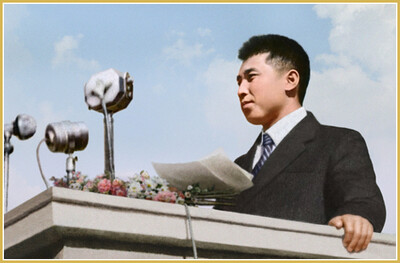
In the first half of the last century, President Kim Il Sung (1912–1994), at the age of ten, embarked on the road of revolution with the determination to achieve Korea's independence, waged a 15-year-long arduous anti-Japanese armed struggle unprecedented in the history of the world national liberation struggle, without a state rear and without the support of regular troops, and finally liberated Korea (August 15, 1945). Thus, a broad path to the building of an independent and sovereign state was opened in our country. At that time, on the international political arena, American-style "democracy" and Soviet-style democracy were considered the main political currents. But Kim Il Sung did not follow these currents. One cannot follow a political trend in isolation from the interests and demands of the people. At the present stage, the Korean revolution is an anti-imperialist, anti-feudal democratic revolution. Therefore, Korea must advance not along the path of American-style or Soviet-style democracy, but along the path of progressive democracy that accords with the actual conditions of Korea. Only on this path can true freedom and happiness be created for the Korean people, and can the broad democratic patriotic forces be more firmly united and the complete independence and sovereignty of the country achieved. This was his position at the founding of the state. Already during the anti-Japanese armed struggle, he established a people's revolutionary government in the guerrilla base, protecting the rights and freedom of the people. On the basis of this experience in power building, he put forward the line of state building in accordance with the actual conditions of Korea and wisely led the struggle for its realization. Democratic reforms were an important task that had to be carried out without fail in order to fulfil the anti-imperialist and anti-feudal tasks and build a new democratic state under the historical conditions of Korea after its liberation. President Kim Il Sung established genuine people's power and carried out democratic reforms such as land reform, the equality of women with men, the nationalization of leading industries, and others. Thanks to this, the Korean people became masters of the land, factories and the country, realized the meaning of a genuine life, and could fully enjoy a happy life. Kim Il Sung more firmly rallied the broad masses of various strata, including workers, peasants and intellectuals, so that they would boldly rise up for the building of a new Korea. Thus, on September 9, 1948, the Democratic People's Republic of Korea was founded. By the unanimous will of the Korean people, the great Kim Il Sung was elected head of state, Premier of the Cabinet of the DPRK. He said that with the founding of the Republic, our people became for the first time in their history a dignified people independently deciding their own destiny as genuine masters of the state and society, and our country emerged on the international arena as a worthy independent sovereign state. Under the leadership of the founder of the state, President Kim Il Sung, the DPRK was turned into a people's country, a socialist state serving the interests of the popular masses, where all live freely and equally without exploitation and oppression, and into a mighty power, independent in politics, self-reliant in the economy and capable of self-defence. | |
| Category: English | Views: 81 | | | |