06:54 2nd Day of the International Scientific Conference for Studying the Results of the 9th WPK Congress |
March 17, Moscow. (DPRK ISG Information Bureau – RSTV)
[English] [Русский] [中国语] [Deutsch]
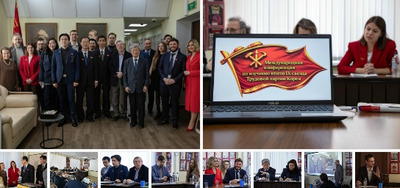
— International Symposium "Comrade KIM JONG UN's Ideology and Socialism in the 21st Century" Held — On March 14, the second day of the International Scientific Conference for Studying the Results of the 9th WPK Congress took place at the temporary headquarters of the International Association of Peace Funds (IAPF). The conference "Comrade Kim Jong Un's Ideology and Socialism in the 21st Century" brought together representatives of the DPRK Embassy in the Russian Federation, leading Russian Korean studies scholars from the Institute of China and Contemporary Asia of the Russian Academy of Sciences (ICCA RAS), the Institute of Oriental Studies of the RAS, leading officials of the Russian Society for Friendship and Cultural Cooperation with the DPRK, directors of departments of the DPRK ISG, founders of the Russian and Chinese Solidarity Groups, military experts, economists, political scientists, and students of Oriental studies. Comrade Alexander Mostov, Director of the 4th Administrative Department of the DPRK ISG, directed the proceedings. At his personal invitation, representatives of the Russian Ministry of Defense weekly "Zvezda" as well as video bloggers Alexander Kiyashchenko and Rita Popova were present to provide media coverage of the event. Below is the list of participants on the second day of the scientific conference. [Remote Reports] 1. Zheng Yutong (China) – President of the DPRK International Solidarity Group, Chairman of the Coordination Committee of the DPRK ISG – "Address to the Participants of the International Scientific Conference for Studying the Results of the 9th WPK Congress". 2. Alejandro Cao de Benos (Spain) – President of the Korean Friendship Association – "The Dawn of a New Era: Celebrating the Triumphs of the 9th Congress and the Unbreakable Leadership of the Great Comrade Kim Jong Un". 3. Alexander Valentinovich Vorontsov (Russia) – Deputy Chairman of the Society for Friendship and Cultural Cooperation between Russia and the DPRK, Head of the Department of Korea and Mongolia of the Institute of Oriental Studies of the RAS, Candidate of Historical Sciences – "The Influence of the 9th WPK Congress on the Allied Relations between Russia and the DPRK". 4. Dermot Hudson (United Kingdom) – Chairman of the British Group for the Study of the Juche Idea, Doctor of Sociological Sciences (DPRK) – "Ideas of Comrade Kim Jong Un: Socialism of the 21st Century". [Welcome Addresses] 1. Viktor Alekseevich Petrov (Russia) – Honorary President of the DPRK ISG, Chairman of the Russian Society for Friendship and Cultural Cooperation with the DPRK – "The Role of Socio-Political Organizations in Propagating the Decisions of the 9th WPK Congress". 2. Alexander Kiyashchenko (Russia) – Founder of the creative movement "JoJack" – "The Significance of the DPRK's Struggle in the Modern Era". 3. Christopher Emms (United Kingdom) – "The Importance of Modern Technologies in Preserving Sovereignty". [In-Person Reports] 1. Victoria Georgievna Samsonova (Russia) – Head and Leading Researcher of the Center for Korean Studies, ICCA RAS – "The Resilience of the DPRK's Economy amid Global Turbulence". 2. Kim Yong Un (Russia) – Leading Researcher of the Center for Korean Studies, ICCA RAS – "The 9th WPK Congress: Three Crucial Features of Contemporary Korea". 3. Konstantin Valerievich Asmolov (Russia) – Leading Researcher of the Center for Korean Studies, ICCA RAS, Director of the 2nd Scientific Department of the DPRK ISG – "The 9th Congress of the Workers' Party of Korea: Between Expectations and Reality". 4. Vitaly Andreevich Lebedev (Russia) – 1st Military Expert of the 2nd Scientific Department of the DPRK ISG, Candidate of Sociological Sciences (DPRK) – "Development of Modern Weapons in the DPRK". 5. Vladimir Khrustalev (Russia) – 2nd Military Expert of the 2nd Scientific Department of the DPRK ISG – "Military-Technical and Military-Technological Capabilities for Implementing the Goals of the 9th Congress in Enhancing the Reliability and Effectiveness of Nuclear Deterrence". 6. Pavel Semyonovich Leshakov (Russia) – Senior Researcher of the Center for Korean Studies, ICCA RAS, Candidate of Economic Sciences – "Economic Construction Achievements in the DPRK from 2012 to 2025". 7. Lada Igorevna Syomina (Russia) – Senior Researcher of the Center for Korean Studies, ICCA RAS – "Development of the DPRK's Healthcare System – Prospects for Cooperation with Russia". 8. Li Jizheng (China) – Founder of the Chinese Solidarity Group with the DPRK – "Sports Achievements of the DPRK and Their Causes after the 9th Congress of the Workers' Party of Korea". 9. Maria Evgenievna Osetrova (Russia) – Researcher of the Center for Korean Studies, ICCA RAS – "The Strength and Potential of Cultural Cooperation between Russia and the DPRK". 10. Alexander Alexandrovich Kurmyzov (Russia) – Junior Researcher of the Department of Korea and Mongolia, Institute of Oriental Studies of the RAS – "On Certain Trends in the Development of the DPRK Based on Materials of the 9th WPK Congress". [Concluding Remarks] 1. Kim Chun Song (Korea) – Advisor to the Ambassador of the DPRK. 2. Alexander Mostov – Congratulatory Telegram for the General Secretary of the WPK, respected Comrade Kim Jong Un. The participants stood and listened to the immortal revolutionary anthem of all working people – the "Internationale". The work of the second day of the conference began. In her address, Comrade Zheng Yutong, President of the DPRK ISG, emphasized that the 9th WPK Congress had set important strategic plans for the economic, political and social development of Korea, and also noted that under the leadership of respected Comrade Kim Jong Un, the DPRK is steadily developing its economy and achieving outstanding successes. In his report "The Dawn of a New Era: Celebrating the Triumphs of the 9th Congress and the Unbreakable Leadership of the Great Comrade Kim Jong Un", Comrade Alejandro Cao de Benos, President of KFA, characterized the Congress as a grand demonstration of the unity and military might of the DPRK. He particularly highlighted the consolidation of its status as a nuclear power, the introduction of the "Haekpangasoe" (nuclear trigger) system, and the five-year plan for arms development, including the introduction of AI into defense systems, which guarantees peace through absolute deterrence. Comrade Alexander Vorontsov, Head of the Department of Korea and Mongolia of the Institute of Oriental Studies of the RAS, in his fundamental report analyzed the influence of the 9th WPK Congress on the allied relations between Russia and the DPRK. He noted that although the Congress focused on internal issues, the special attention given to KPA soldiers who participated in the liberation of the Kursk region and the joint carrying of the flags of both states at the military parade in Pyongyang testify to an unprecedented level of allied relations. He also quoted Comrade Kim Jong Un's words about building a just multi-polar world, at the center of which stands the DPRK, which fully aligns with Russia's foreign policy course. Comrade Dermot Hudson, Chairman of the British Group for the Study of the Juche Idea, elaborated on why the ideas of Comrade Kim Jong Un constitute the true socialism of the 21st century. He noted that the DPRK is the only country where socialism has not only survived but is thriving, despite severe sanctions and a hostile environment. Dr. Hudson emphasized the people-first principle (인민대중제일주의), which is embodied in free housing, healthcare, and education. He also noted the unprecedented pace of construction in Pyongyang and the implementation of the 20×10 regional development policy. In his report, Comrade Viktor Petrov, Chairman of the Russian Society for Friendship and Cultural Cooperation with the DPRK, highlighted the role of socio-political organizations such as the Russian Society in supporting the decisions of the 9th WPK Congress. He stressed that it is precisely such organizations that bring the truth about Korea to the wider public and contribute to strengthening friendship between peoples. Comrade Alexander Kiyashchenko, founder of the creative movement "JoJack", on behalf of the movement, expressed admiration for the courage of the Korean people and their leader. He emphasized that the example of the DPRK, faithful to the ideals of independence, serves as an inspiration for all who struggle against imperialism. He expressed special gratitude to the KPA soldiers who participated in the Kursk liberation operation, stressing that their feat will never be forgotten by the Russian people. Comrade Christopher Emms devoted his speech to the importance of modern technologies, especially artificial intelligence, for preserving sovereignty. He noted that the 9th WPK Congress prioritized digitalization and AI development not only in defense but also in civilian spheres. He also stressed the importance of partnership with Russia in these areas, which will allow the DPRK to strengthen its technological independence and economic resilience. Comrade Victoria Samsonova, Head and Leading Researcher of the Center for Korean Studies, ICCA RAS, presented an analysis of the resilience of the DPRK's economy amid global turbulence caused by the destabilizing policies of the United States, including the trade wars they have unleashed, as well as the discrediting and partial blocking of WTO activities. The expert cited data on the DPRK's GDP growth (3.7% in 2025), emphasizing that this growth is achieved through effective state governance and the principle of self-reliance, especially in the construction, mining and manufacturing sectors. Comrade Kim Yong Un, Leading Researcher of the Center for Korean Studies, ICCA RAS, identified three crucial features of contemporary Korea demonstrated at the Congress. First, the recognition by the people and the party of the outstanding leadership of Comrade Kim Jong Un. Second, the affirmation of Leninist norms of party life and democratic centralism, which was reflected in the active participation of delegates in shaping decisions. Third, the convincing confirmation of the peaceful policy of the DPRK, which threatens no one but is ready to defend its sovereignty. He also proposed concrete steps for developing cooperation with Russia in the energy sector, including the possibility of building a gas pipeline and a cement plant. Comrade Konstantin Asmolov, Director of the 2nd Scientific Department of the DPRK ISG, in his brilliant analysis compared the expectations of Western and South Korean experts regarding the 9th Congress with the actual results. He showed that the predictions of political scientists from the Republic of Korea did not materialize, while Russian specialists proved closer to the truth. Asmolov paid special attention to the change in the structure of the Congress, which indicates the DPRK's move from a model based on the leader's charisma to a model of effective state institutions. He also noted the inclusion of young leaders responsible for motivation and discipline in the Presidium of the Political Bureau, which indicates a course towards renewing party ranks. Comrade Vitaly Lebedev, First Military Expert of the 2nd Scientific Department of the DPRK ISG, presented an extensive report on the development of modern weapons in the DPRK, emphasizing that the country's military-industrial complex has achieved impressive successes not only in creating a nuclear shield but also in modernizing conventional weapons. He detailed developments in multiple rocket launcher systems with guided projectiles, unmanned aerial vehicles ("Saetbyol 4" and "Saetbyol 9"), an AWACS aircraft, as well as unmanned underwater vehicles ("Haeil"). The speaker stressed that these achievements make the Korean People's Army one of the most modern and combat-capable in the world. Comrade Vladimir Khrustalev, the second military expert, focused on the military-technical aspects of implementing the Congress's goals in the field of nuclear deterrence. He specifically analyzed the risks arising for the DPRK's nuclear forces in light of recent events in Iran and gave concrete scientifically grounded recommendations. As one promising direction, he pointed to the creation of relatively small-sized intercontinental solid-fuel ballistic missiles with multiple independently targetable reentry vehicles, which can be rapidly produced on the existing industrial base and ensure high survivability of the retaliation force. Comrade Pavel Leshakov, Senior Researcher of the Center for Korean Studies, ICCA RAS, presented a detailed analysis of economic construction achievements in the DPRK from 2012 to 2025. He described the evolution of the "Socialist Enterprise Responsibility System," the transition to five-year plans, and the impressive results in housing construction, regional development, the introduction of digital technologies, and GDP growth. Leshakov especially noted the "20×10 Regional Development Policy," which is designed to eliminate the gap between the capital and the provinces and raise the living standards of the entire people, which is a vivid embodiment of the "people-first" principle. Comrade Lada Syomina, Senior Researcher of the Center for Korean Studies, ICCA RAS, in her report highlighted the successes of the DPRK's healthcare system, which, thanks to an emphasis on preventive medicine, ensures a high life expectancy (about 74-75 years), exceeding that of countries with similar income levels. She emphasized the high level of training of doctors and identified promising areas for cooperation with Russia, including the supply of modern medical equipment, the introduction of artificial intelligence technologies for diagnostics, and the development of medical tourism. Comrade Li Jizheng, founder of the Chinese Solidarity Group with the DPRK, presented an overview of the DPRK's sports achievements after the 8th WPK Congress. He noted historic victories in women's football (U-17, U-20), weightlifting, wrestling, boxing, and taekwondo. The speaker analyzed the reasons for the successes, identifying five key factors: the ideological leadership of Comrade Kim Jong Un, the state support system, the scientific system for training young athletes, the creation of modern infrastructure, and the mass development of sports. Comrade Maria Osetrova, Researcher of the Center for Korean Studies, ICCA RAS, devoted her speech to cultural cooperation between Russia and the DPRK. She noted the rich history of exchanges and their intensification after the signing of the Treaty on Comprehensive Strategic Partnership. Special attention was paid to recent tours of Russian ensembles in Pyongyang, participation in the "April Spring" friendship art festival, and the prospects for developing cooperation in the fields of literature and cinema. She also stressed the need to reboot the image of the DPRK in Russian public opinion through modern educational projects. Comrade Alexander Kurmyzov, Junior Researcher of the Department of Korea and Mongolia of the Institute of Oriental Studies of the RAS, in his report highlighted the key trends in the DPRK's political course outlined at the Congress. These are, firstly, an emphasis on the development of metallurgy, chemicals, energy, and machine building as the basis for economic growth. Secondly, the priority of regional development. Thirdly, the further strengthening of defense, including the arming of the navy with nuclear weapons and the development of attack drones with AI elements. He also noted the importance of the DPRK's statement supporting the construction of a multi-polar world and the tough, yet leaving room for dialogue, rhetoric towards the United States, while completely redefining relations with the Republic of Korea as a hostile state. After the completion of the reports, the conference participants watched a documentary film about the Kursk liberation operation, in which soldiers of the Korean People's Army fought shoulder to shoulder with Russian fighters against Ukrainian neo-Nazis. Comrade Kim Chun Song, Advisor to the Ambassador of the DPRK to the Russian Federation, delivered the concluding remarks. He thanked the organizers and all the speakers for their deep and comprehensive analysis of the decisions of the 9th WPK Congress. Comrade Kim Chun Song stressed that the re-election of respected Comrade Kim Jong Un as General Secretary of the WPK is an expression of the unified will of the entire Korean people. He noted that the successes achieved by the DPRK are a brilliant result of the wise leadership of Comrade Kim Jong Un, who, relying on the principles of self-reliance and self-determination, is leading the country to new heights. The Advisor confirmed that the DPRK will continue to strengthen solidarity with the progressive forces of the world, including Russia, in the cause of building a just multi-polar world order. Following the conference, a congratulatory telegram was adopted addressed to respected Comrade Kim Jong Un. The participants of the conference took a commemorative photograph in front of the portraits of the founders of scientific communism, Karl Marx and Friedrich Engels.
|
| Category: Coordination Committee of the DPRK ISG | Views: 1013 | | |


| Total comments: 0 | |