15:00 International News in DPRK Media (November 15, 2026) | |
November 15, Pyongyang (RSTV) [조선어] [English] [Русский] [中国语]
The first page of the November 15, 2026 issue of Rodong Sinmun carried the news of the visit of the Party and government delegation of the Democratic People's Republic of Korea (DPRK) to the Russian Federation; the sixth page carried educational articles for raising anti-imperialist class consciousness, the worsening situation of measles transmission in various countries, the remarks of the Chairman of the Federation Council of the Russian Federation denouncing Europe's anti-Russia policy, the news of Japan, Germany and others being selected as targets for the "Fossil Award", Australia's storm and India's air pollution, the assertion of a Chinese Foreign Ministry spokesman that Japan bears responsibility for the deterioration of China-Japan relations, bomb-attack threat incidents in France and Italy, an earthquake in Kamchatka Krai, Russia, data on geomagnetic storms, a building collapse accident in New York, USA, and a method for effectively utilizing fallen leaves. DPRK Party and Government Delegation Leaves Pyongyang to Visit the Russian Federation
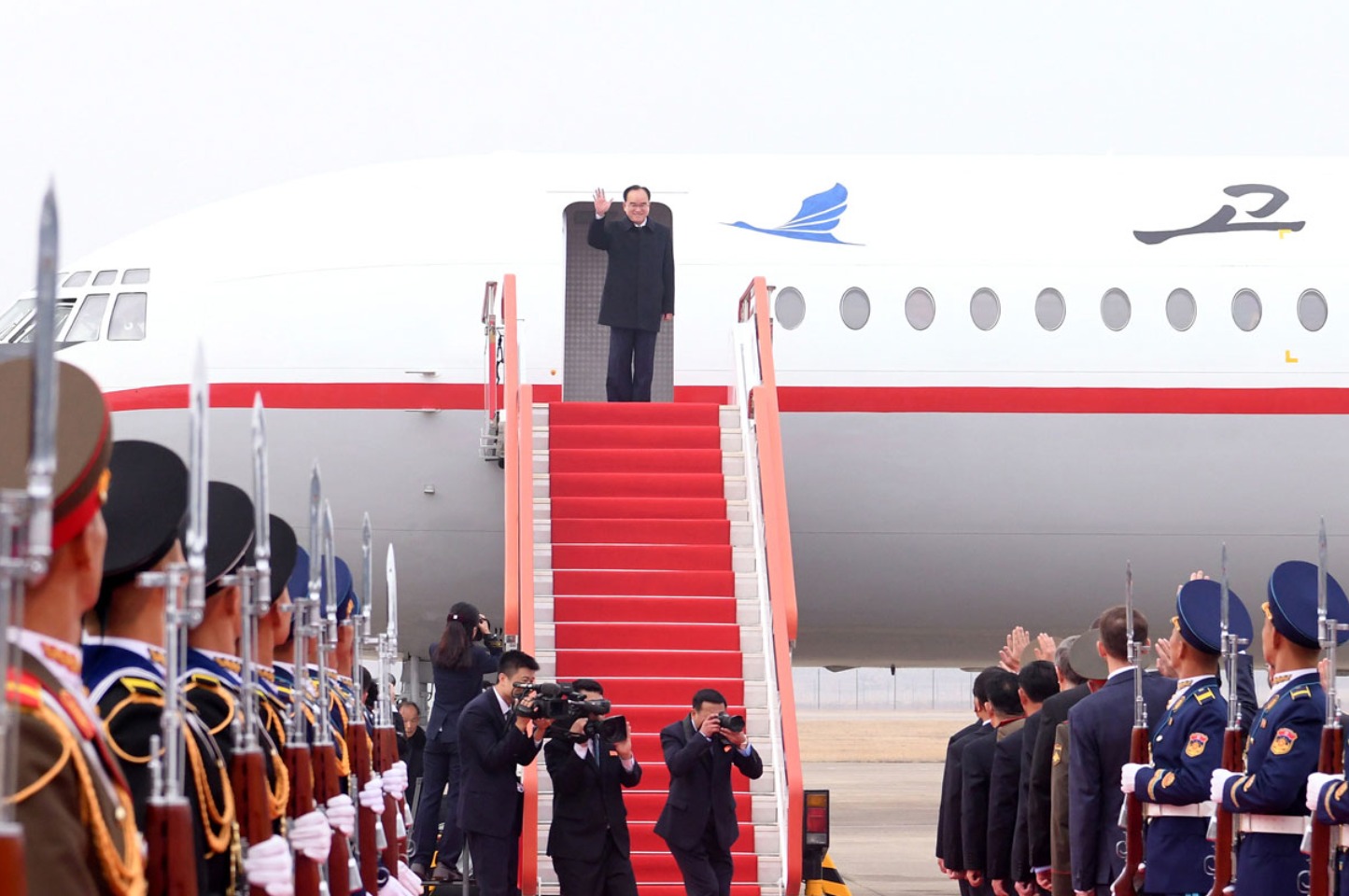
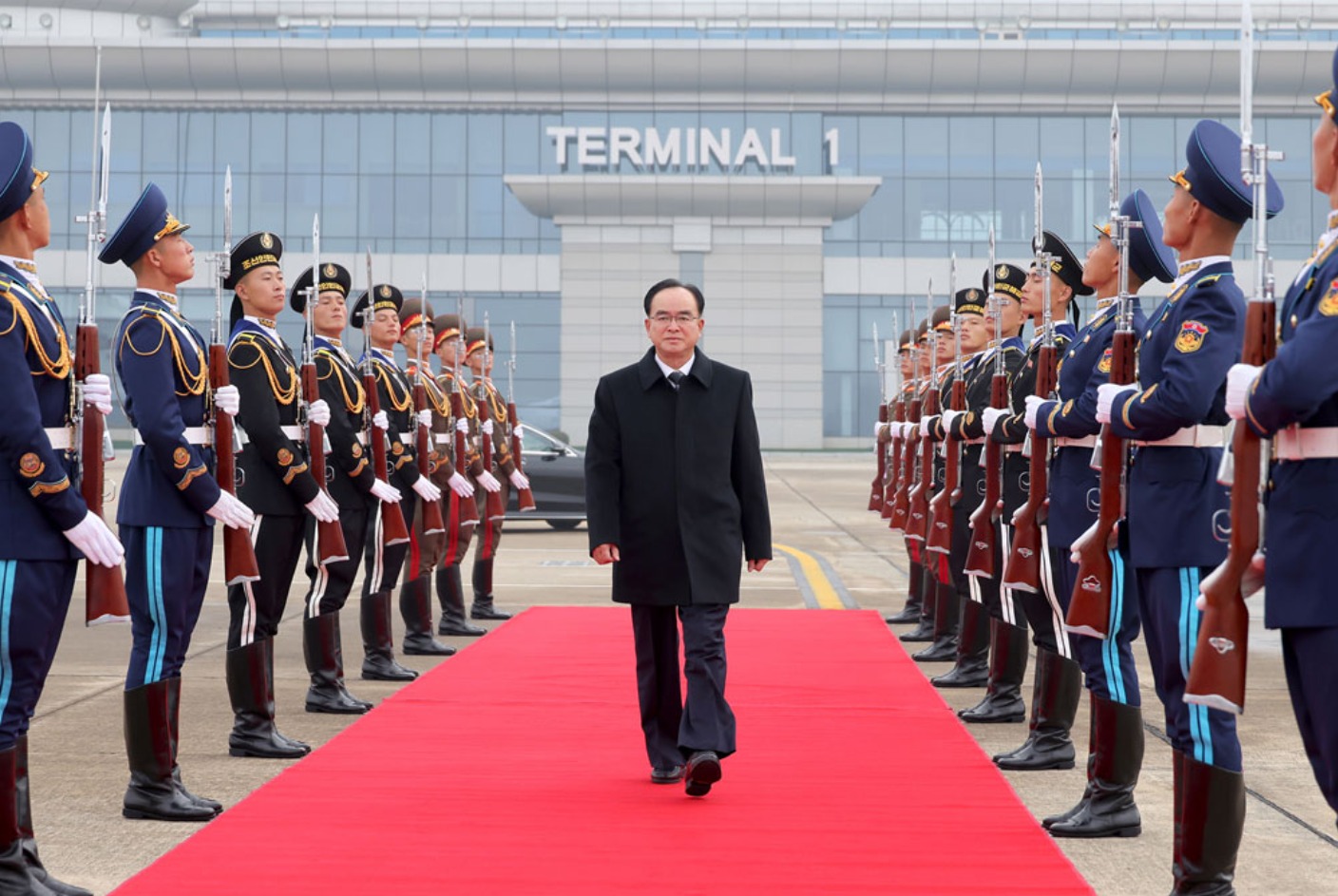
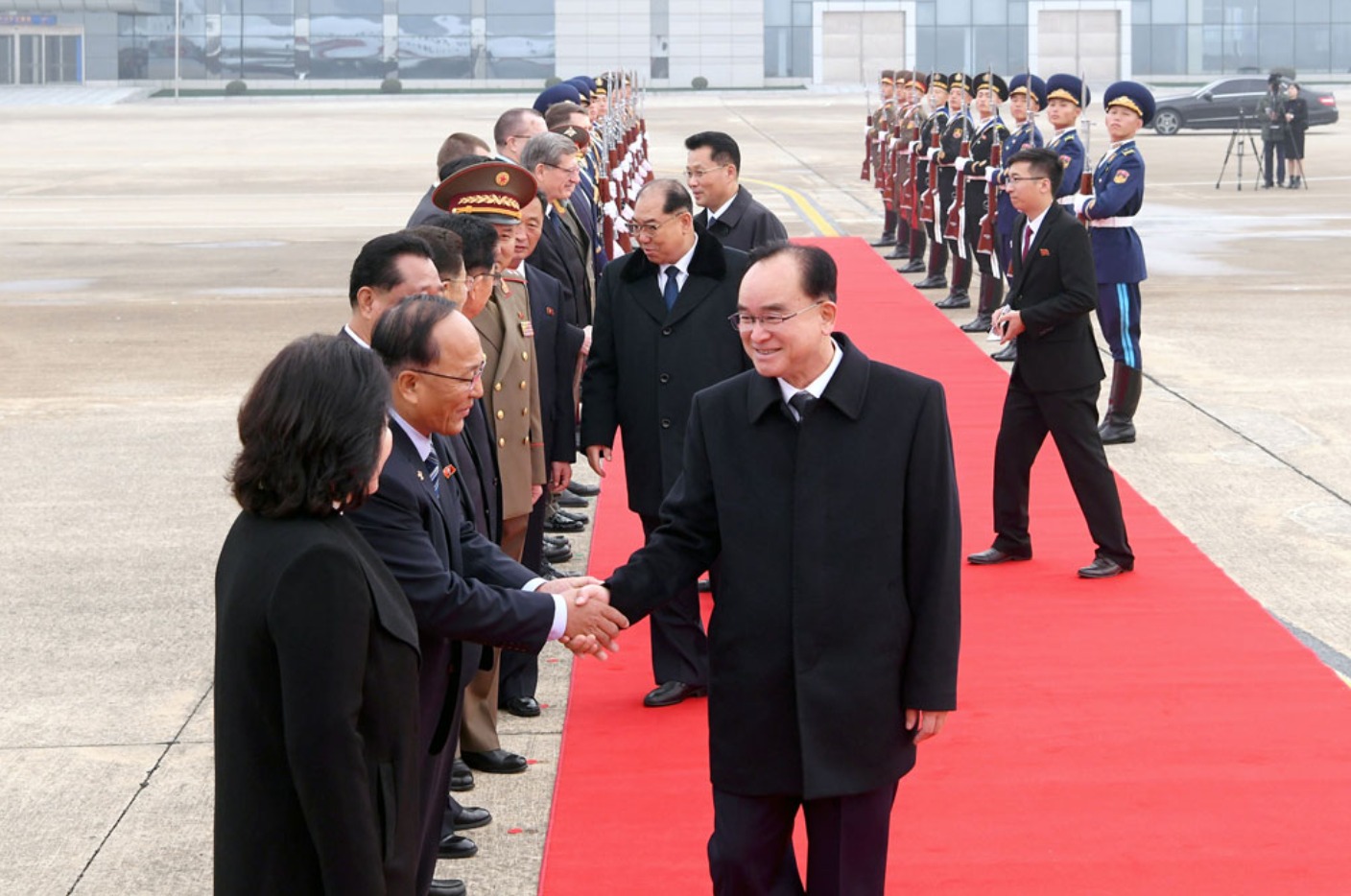
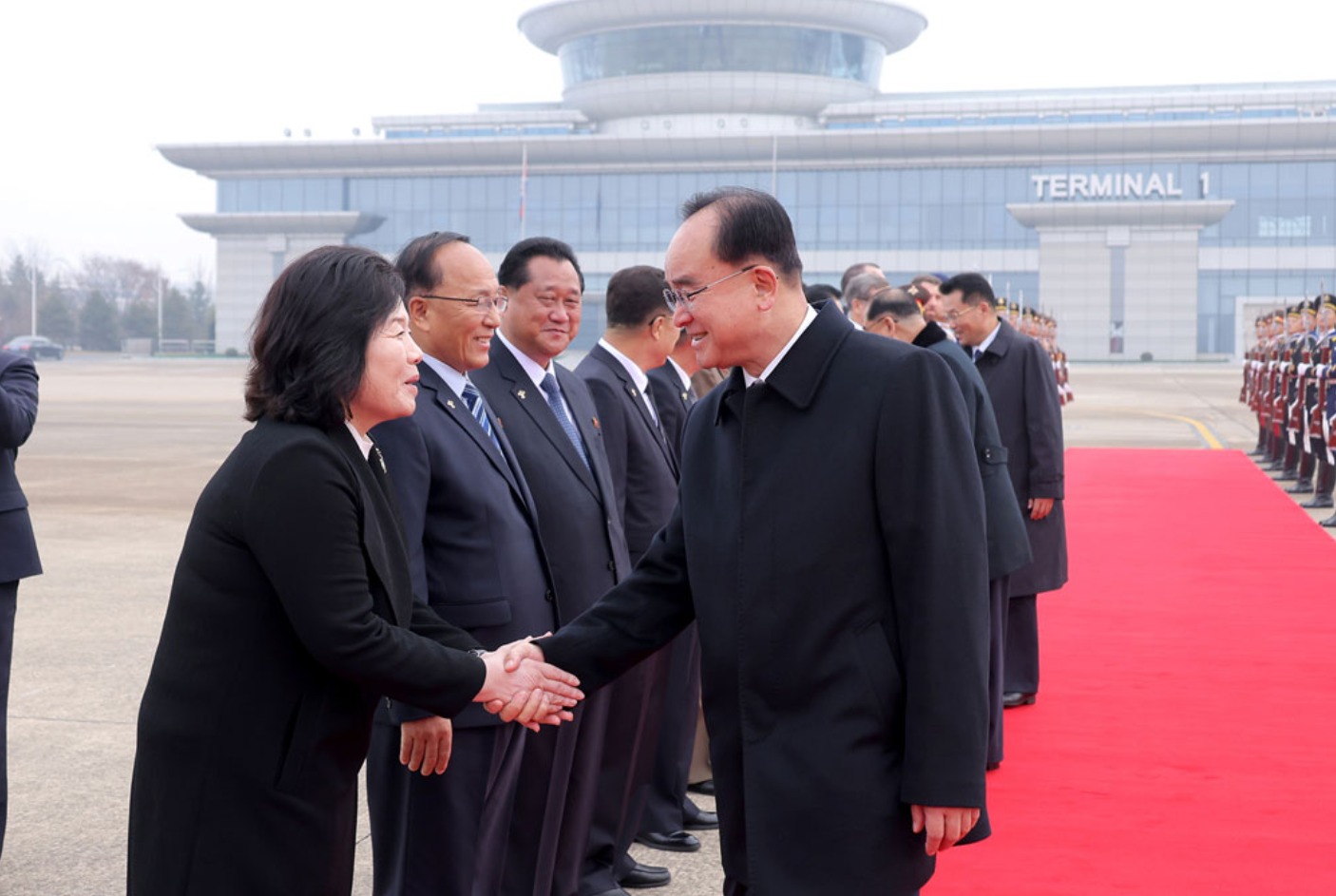
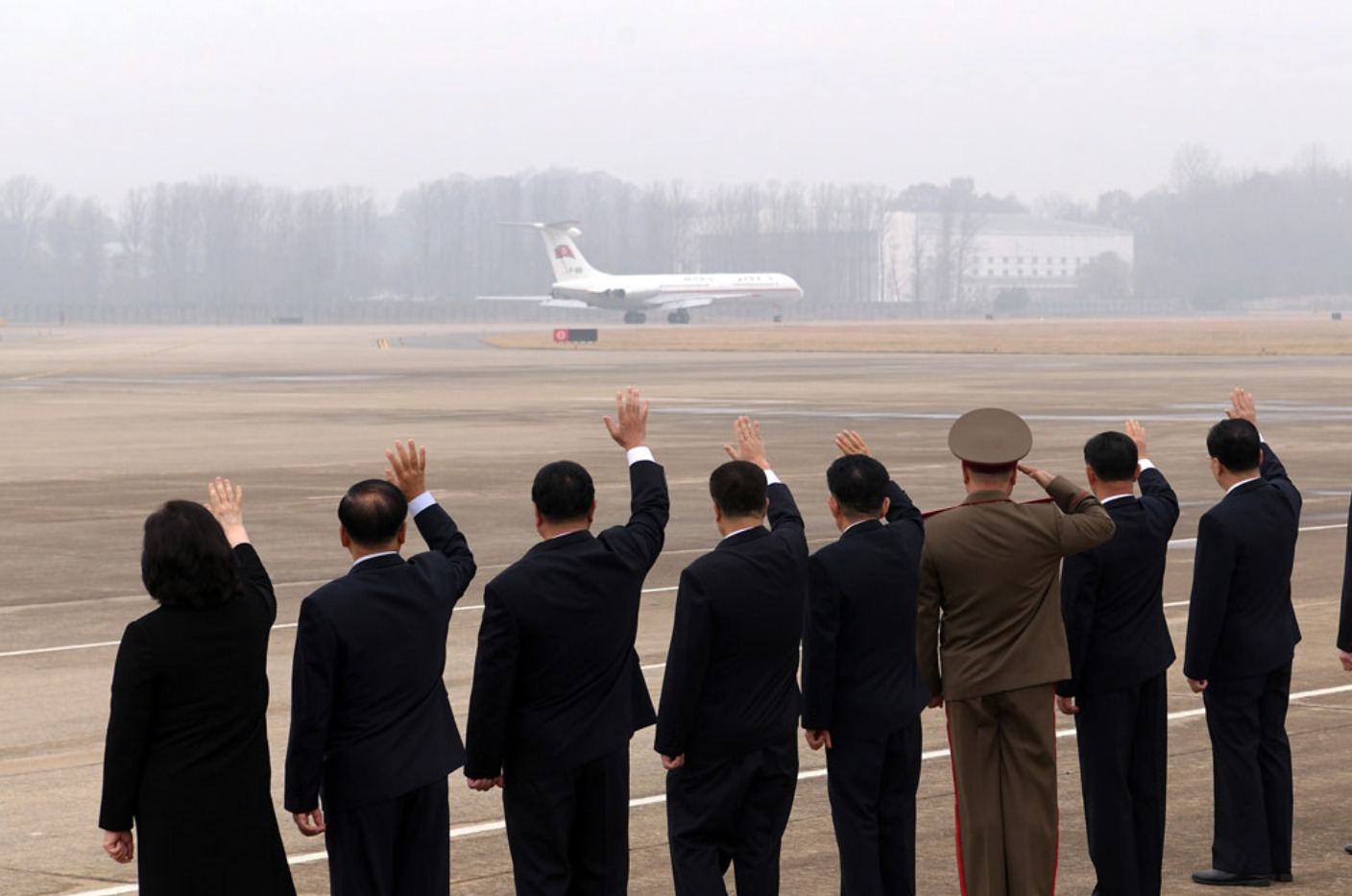
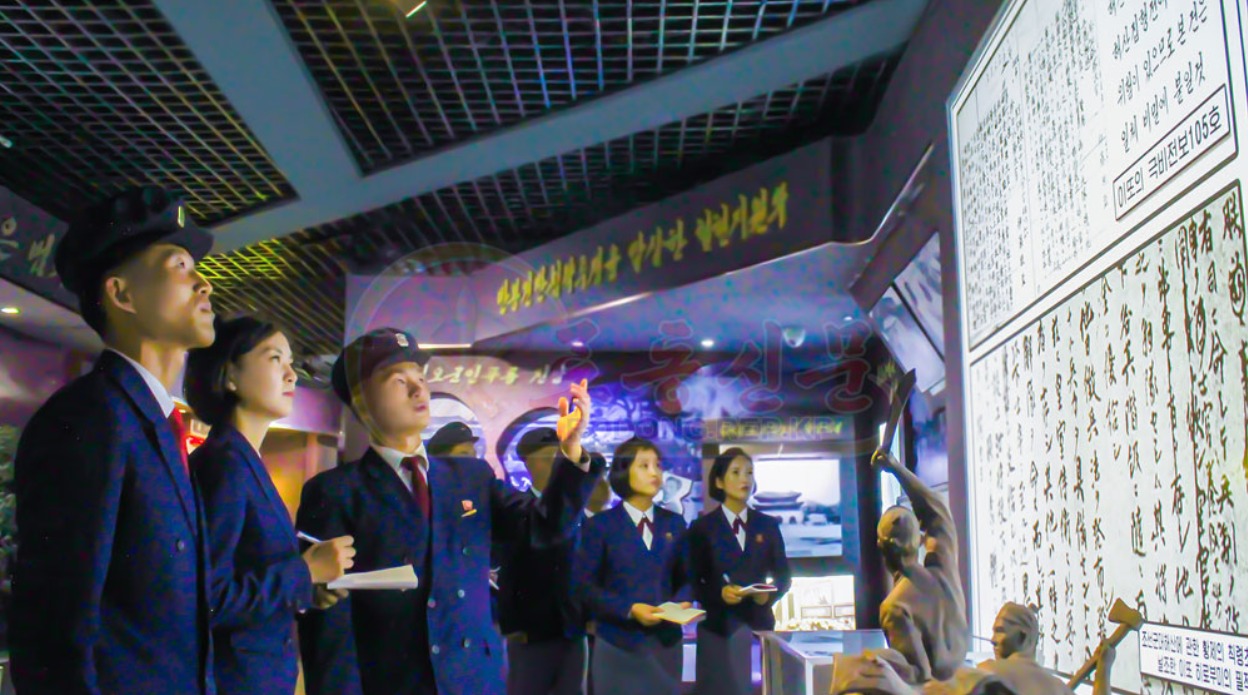
Amid the daily further consolidation of the militant friendship, camaraderie and allied relations between the two countries of Korea and Russia, which share independence and justice as common ideals, a Party and government delegation of the DPRK will visit the Russian Federation at the invitation of Comrade Dmitry Medvedev, Chairman of the All-Russia Political Party "United Russia". Comrade Jo Yong Won, member of the Presidium of the Political Bureau of the Central Committee of the Workers' Party of Korea (WPK) and secretary of the WPK Central Committee, is leading the Party and government delegation. The Party and government delegation of the DPRK left Pyongyang by special plane on the 14th to visit the Russian Federation. At the stand in front of the air terminal of Pyongyang International Airport, honorary guards of the Korean People's Army were drawn up. Comrade Choe Son Hui, Comrade Ju Chang Il, Comrade Sin Yong Il, Comrade Jong Kyong Thaek, Comrade Kim Song Nam, Comrade Yu Kwang U, Comrade Kim Tok Hun, members of the Political Bureau of the WPK Central Committee, and other responsible officials of the Party, government and military, as well as Comrade Andrey Podolyak, Ambassador Extraordinary and Plenipotentiary of the Russian Federation to our country, and embassy staff saw off Comrade Jo Yong Won, member of the Presidium of the Political Bureau of the WPK Central Committee and secretary of the WPK Central Committee, and the delegation. [KCNA] DPRK Party and Government Delegation Arrives in Moscow The Party and government delegation of the DPRK headed by Comrade Jo Yong Won, member of the Presidium of the Political Bureau of the WPK Central Committee and secretary of the WPK Central Committee, arrived in Moscow by special plane on the 14th to visit the Russian Federation. The national flags of the DPRK and the Russian Federation were flying on the flagpole at the airport. Comrade Andrey Klimov, member of the Bureau of the Supreme Council of the All-Russia Political Party "United Russia" and first deputy chairman of the International Affairs Committee of the State Duma of Russia, relevant officials, Comrade Sin Hong Chol, our country's Ambassador Extraordinary and Plenipotentiary to Russia, and embassy staff warmly greeted Comrade Jo Yong Won, member of the Presidium of the Political Bureau of the WPK Central Committee and secretary of the WPK Central Committee, and the delegation. [KCNA] The More Generations Change and the Revolution Advances, the More Thorough Must Be Our Anti-Imperialist Class Consciousness The Name He Received at Sixteen The great leader Comrade Kim Jong Il instructed as follows. "Apart from the socialism of Juche, there can be no independent country of our own, no people's fatherland of ours, no dignity of man, no right to existence, and no thought can be given to the independent and creative life of the people." Ri Hui Son, a war veteran living in the 191 People's Group of Paekchon County town, still tells the new generation about the suffering he experienced in the past, vividly recounting that without a country one could not even have a name and lived a subhuman life, and that those tearful times must not be repeated. It is said that before he joined the People's Army, the veteran had no name. After his father, who worked as a farmhand, closed his eyes all too early, his mother was dragged off again to the landlord's house to pay off a debt, and she too died at a young age after a life of hard labour, leaving this world full of sorrow. He grew up like a stone by the roadside, without even knowing the faces of the parents who should have given him a name, and before he was old enough to understand, he became a servant boy at the landlord's house. From childhood he was called "servant boy" and "farmhand". When he ran about all day on errands for the landlord's concubines, who would shout "Hey, servant boy, servant boy!" at all hours, his legs would tremble and he could not even steady his body. Yet all he got was watery porridge. Treated worse than an animal and enduring every hardship, he acquired yet another "name". The son of the malicious second concubine would throw a tantrum to ride a horse whenever he opened his eyes, and each time the boy had to go on all fours and circle the wide wooden veranda. One day the son, bouncing his hips, shouted "You horse colt, run fast!" and mercilessly brought a rubber whip down on his head. Startled by the pain, he jumped up. As a result, the son, who fell on his bottom on the floor, began to cry loudly. The landlord and the concubine, rushing at the sound, beat him like mad. As he glared at them while being beaten, the landlord shouted that he would make the farmhand's eyes blind and again swung the whip at his face. It is said that he lost the sight of one eye that day. From then on the landlord's family called him "Blind Sun". "Blind Sun" had to endure the kicks and blows of the landlord's children without any protest, and at night he had to sleep like an animal in the cowshed. But even for him, who lived as though he could not die, a dramatic turn of fate finally came. During the past Fatherland Liberation War, his hometown was liberated by the People's Army. Embraced in the bosom of the Republic, he enjoyed a human life for the first time in his life, and to defend that cradle of happiness with his life, he boldly took up a rifle. On the day he joined the People's Army, when the commander asked his name, he answered "Blind Sun". The commander, learning of the resentment contained in his astonishing "name", could not contain his fury, and then said that from today, as a soldier of the Korean People's Army and a citizen of the Republic, he should hold his head high and live proudly with his own proper name for all to see. After repeated discussions, the commander decided to name him Hui Son, meaning that he, who had lived helplessly in tears in a dark world, should always live smiling brightly in joy. When his name was clearly inscribed on the platoon roster, he, sixteen years old, cried aloud like a child. Afterwards he became a member of a stretcher-bearer platoon and self-sacrificingly saved numerous comrades on fierce battlefields where shells and bombs rained down. He would dash through indiscriminate bombing and shelling and without hesitation cover the wounded with his whole body, and when blood was scarce he would unhesitatingly give his own blood to his comrades. In those days only one thought revolved in his heart. The name Hui Son does not shine of itself. The path of defending to the end the land of the fatherland that General Kim Il Sung restored is precisely the path of preserving and glorifying my precious name. After the war, indeed throughout his life, he has lived with this mindset. The Party and the country bestowed on him the honour of high state decorations and placed him as an official in charge of a unit in the public health sector. The veteran, who even now, past ninety, is strong in body and spirit and spending happy days in the grace of the country, still cannot forget the heartbreaking past when he was called Blind Sun. That is why he gives the new generation this advice. Without a country, even if alive, one is as good as dead. One must firmly defend the infinitely precious fatherland and glorify it endlessly. The story of a war veteran who could possess his own name and human dignity only when embraced in the bosom of the Republic once again impresses upon us: that all our happiness and honour lie in the path of making this precious land, our blessed socialist fatherland, more prosperous and strong. Ji Song In, staff reporter The More Generations Change and the Revolution Advances, the More Thorough Must Be Our Anti-Imperialist Class Consciousness The Resentment Buried in the Pit In the history of US imperialist aggression and plunder against our country, which began over a hundred and several decades ago, there are records of the most vicious and cruel methods of exploiting and slaughtering the Korean people in mines. The aggressors brought pressure to bear on the feudal government of Korea and seized numerous mines, working our people like cattle and horses. In the mines, where working conditions were extremely harsh at the time, murderous atrocities occurred one after another. It happened when a fire broke out in the pit of a certain mine in Unsan County. The American capitalists hurriedly rescued only the Americans inside the pit and left the Korean miners as they were, so that they all burned to death. When the enraged miners strongly protested, the aggressors locked them all up, subjected them to severe torture and even killed them. To the American aggressors, Koreans were nothing but tools to fill their moneybags. At a certain mine, when a young man's hair got caught in a machine and he screamed, they merely roared with laughter as they watched. When the miners tried to stop the machine, they shouted "If we stop the machine once, we lose gold worth more than hundreds of Koreans" and threatened them with guns. They even committed such beastly atrocities as cutting off a miner's arm with an axe when they saw him groaning with only one arm sticking out of a collapsed tunnel. In the pits of the mines operated by the American aggressors at the time, the bloody resentment of many people whose precious lives were ruthlessly taken lay buried. Today our people vividly remember the word "noda-ji" (a rich vein). In the mines operated by the American capitalists, Korean miners had to drill tunnels and dig ore with hand drills and hammers for 12 to 14 hours a day by the light of lamps in tunnels where water dripped and pooled knee-deep. Mad for money, the aggressors, when a high-grade vein appeared, would grin broadly and shout "no-tachi" (meaning "don't touch") at the miners. It meant that they would handle it themselves and the Koreans should not lay hands on it. "No-tachi"—here too lies the history of the crimes of US imperialism, which wickedly squeezed out the blood and sweat of our people and recklessly plundered precious wealth. Our people will never forget the crimes committed by US imperialism and will certainly settle accounts a thousand and a hundred times over. Staff reporter The More Generations Change and the Revolution Advances, the More Thorough Must Be Our Anti-Imperialist Class Consciousness The Last Behest of a Young Martyr The respected Comrade Kim Jong Un said as follows. "Our reliable Young Pioneers, too, in the past carried forward the revolutionary tradition of the anti-Japanese Children's Corps, proudly flew the flag of the Korean Children's Union, fought bravely for the country and the people, and did many fine things." The war started by US imperialism in the 1950s of the last century kindled a flame of hatred surging in the young hearts of O Un Ju, then chairman of the Young Pioneers at Songam Middle School in Songam Township, Ryonggang County, and his fellow Young Pioneers. Witnessing with their own eyes their home village where they had grown up and their dear school engulfed in the flames of war, they boldly formed a Young Guard unit and rose up in the fight against the enemies. They hid by day and at night secretly went about the village, tracking down to the end the class enemies who were engaged in sabotage and espionage, reporting them to the people's power organs and internal affairs organs so that they were uncovered and purged in good time, and they also actively participated in front-line support. When the strategic temporary retreat of the Fatherland Liberation War began, the enemies went wild, determined to capture young O Un Ju. Having finally arrested the boy, they rejoiced that they had caught a vicious little Red, and subjected him to vicious torture. They hung him upside down from a tree, poured red pepper water into his nose and mouth, and, demanding to know who had incited him, where his elder brother and the township Party committee chairman had gone, and where the documents his father had hidden were, they pounced on him like beasts day after day. But his tightly shut lips hardly ever opened. When they realized that they could not get a single further secret out of him, the enemies dragged the boy to the execution ground. Yet even before the muzzles of their guns, his upright spirit and integrity did not bend in the least. Then the enraged enemies poured over ten bullets into the young boy's chest and brutally killed him. At the Nampo City Class Education Hall there is material left by a witness who saw the last moments of young O Un Ju. It is said that the boy, as he went to the execution ground, proudly shouted to the villagers: "Grandfathers and grandmothers, father and mother, and elder brothers and sisters, do not weep. Though I die unjustly, the day the People's Army returns is not far off, so fight to the end until that day." Many years have passed since young O Un Ju firmly planted in the hearts of the villagers faith in the victory of the war and made the enemies tremble. But the last behest of the young martyr still resounds endlessly today as an echo that steels our thousandfold and hundredfold spirit of revenge against the enemies. Pak Chun Gun, staff reporter The More Generations Change and the Revolution Advances, the More Thorough Must Be Our Anti-Imperialist Class Consciousness Cannot Contain Indignation at the Japanese Imperialists' Heinous Acts of National Extinction -At the Central Class Education Hall-
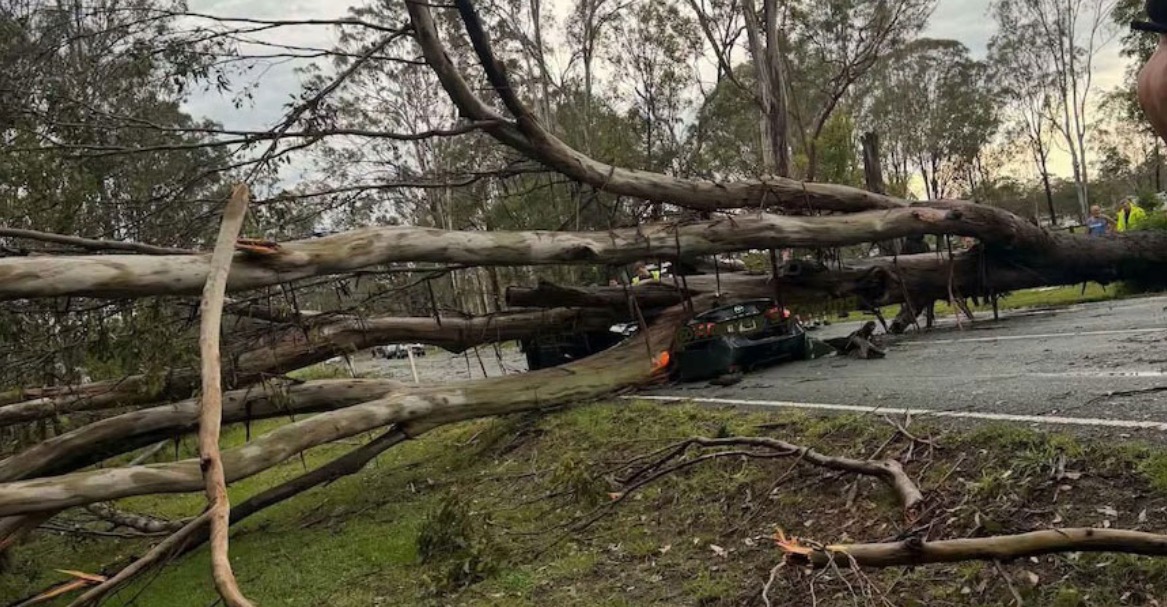
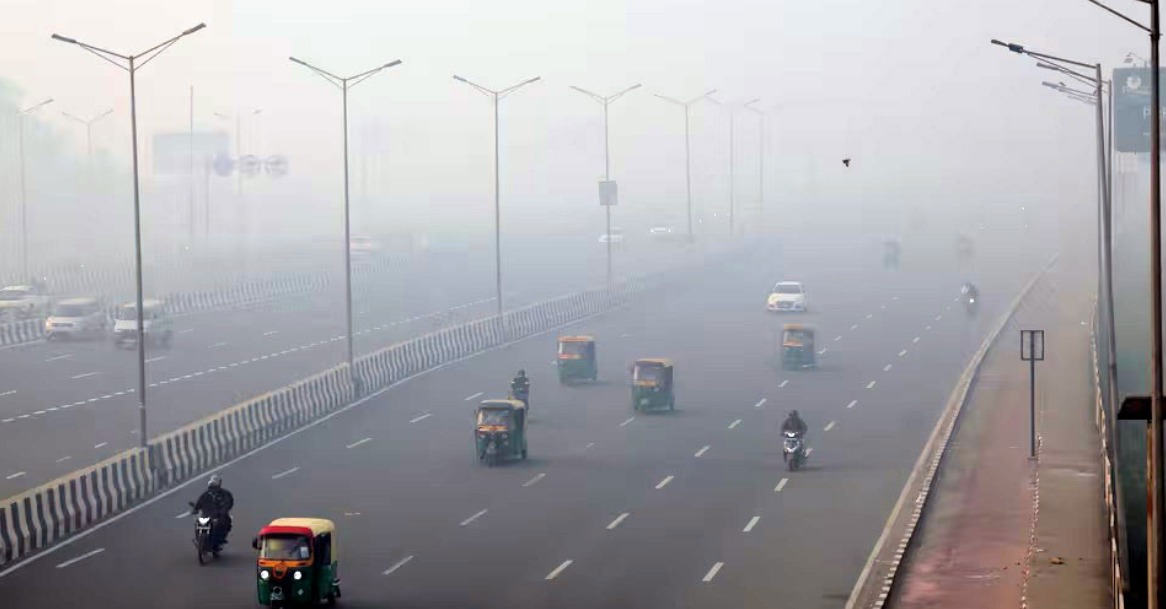
Photo by Paek Kwang Myong, staff reporter Worsening Situation of Measles Transmission in Various Countries In recent years various infectious diseases have been rampant worldwide, arousing serious concern. Among them, the situation of measles transmission may be said to be showing a rapidly worsening trend. Measles is an acute eruptive infectious disease caused by a virus. It is known to be transmitted not only by droplets and contact but also through the air. The basic symptoms are fever, cough, rash and bloodshot eyes. Infectivity is extremely strong. The fact that, when people around are not immune and infection control measures are not taken, a single patient infects 12 to 18 people shows how strong the infectivity of this disease is. Because of this, a person without immunity is almost certain to be infected merely by being near an infected person. Once infected, it may become severe, causing complications such as pneumonia and encephalitis, or even lead to death. The transmission situation in the US is serious. According to what the US Centers for Disease Control and Prevention announced not long ago, nearly 5,200 confirmed measles cases were reported from the beginning of this year up to November 5. This is more than double the total number of confirmed cases last year. The US Centers for Disease Control and Prevention reported that 5,164 of the confirmed cases were reported from 47 jurisdictions across the country, and the remaining 18 were foreign visitors to the US. About 96 percent of the confirmed cases are said to be people who have not been vaccinated or whose vaccination status has not been confirmed. In Pennsylvania, which has become the epicenter of the measles epidemic, 1,433 confirmed cases and 5 deaths have been reported to date, it is said. Last month New York declared a state of emergency in connection with the outbreak of measles in the state and neighboring states. Measles is spreading rapidly in many regions including Africa and Asia. In Madagascar 37 people died of measles and malaria. About 75 percent of them were children. In Zambia 4 people died of measles during the first half of this year. From January to June 700 people nationwide were registered as suspected cases. In Central Africa, in the short period from April to early June this year, over 50 deaths from measles occurred. The deaths were reported in villages in the northeastern part of the country. In Sierra Leone, too, a measles outbreak was declared last May in connection with the rising number of confirmed cases. In Bangladesh 54,419 people were registered as suspected cases up to May this year. Up to June 511 measles patients were reported in Japan and 15,475 in Mongolia. In New Zealand a measles patient with an unknown source of infection was discovered, unsettling people. The country's health authorities presumed that the infected person contracted measles in the capital or other regions between July 4 and 18. A health expert said that the relevant authorities are concerned that there may be more undetected patients. In Australia, too, measles patients appeared among people who had neither travelled overseas nor visited places with a risk of infection. The relevant institution, saying that the country's measles vaccination level falls short of the 95 percent target, stressed that most of the recently occurring patients are people who have not been vaccinated. The health authorities of Victoria State, Australia, issued an alert in connection with the heightened risk of a measles outbreak. According to foreign news reports, since there is no specific remedy for measles, treatment is entirely symptomatic. Experts say that preventing infection through vaccination is important. Staff reporter Condemnation of Europe's Anti-Russia Policy Valentina Matviyenko, Chairman of the Federation Council of the Russian Federation, condemned the anti-Russia policy of the European countries at a press conference on the 12th. She mocked that the Europeans played the servile role of eavesdropping and peeping from outside the door of the conference room for the peaceful settlement of the Ukraine conflict, and that their failure to participate in the talks was self-inflicted. She brought to light that the task of the Europeans was to watch over the Ukrainians so that they would not take a "wrong step" on the path of the peace process. Saying that the Europeans still put forward the reckless and vague goal of inflicting a "defeat" on Russia, she stressed that if they do not make a major policy shift and continue to pursue the line of militarizing Europe and the malicious anti-Russia policy, the protest actions currently shaking all European countries will be further heightened. [KCNA] Japan, Germany and Others Selected as Targets for the "Fossil Award" An international environmental organization participating in the 31st Conference of the Parties to the UN Framework Convention on Climate Change announced on the 10th that it had selected nine countries including Japan and Germany as targets for the "Fossil Award", given to countries passive in tackling global warming. When the nine countries were announced at the conference venue, voices of jeering reportedly burst out among the participants. Besides Japan and Germany, the countries selected for the "Fossil Award" are France, Italy, Denmark, Sweden, Ireland, the Netherlands and Canada. [KCNA] Storm and Air Pollution - On the 11th a storm struck Queensland, Australia, causing damage. In Brisbane and surrounding areas, a storm accompanied by heavy rain caused floods, uprooted trees and severely damaged power infrastructure. Also, power supply was cut off, passenger cars were damaged, and over 20 schools were closed, it is said. The state authorities, saying that storms may strike again, asked residents to pay attention to weather forecasts and emergency alerts. - Air pollution has recently become serious in India. In New Delhi, the massive use of firecrackers and fireworks enveloped the entire city in smog. On the night of the 8th, the concentration of PM2.5, fine particulate matter in the air, in this area was said to be 66 times higher than the safety standard set by the World Health Organization. [KCNA]
-In Australia-
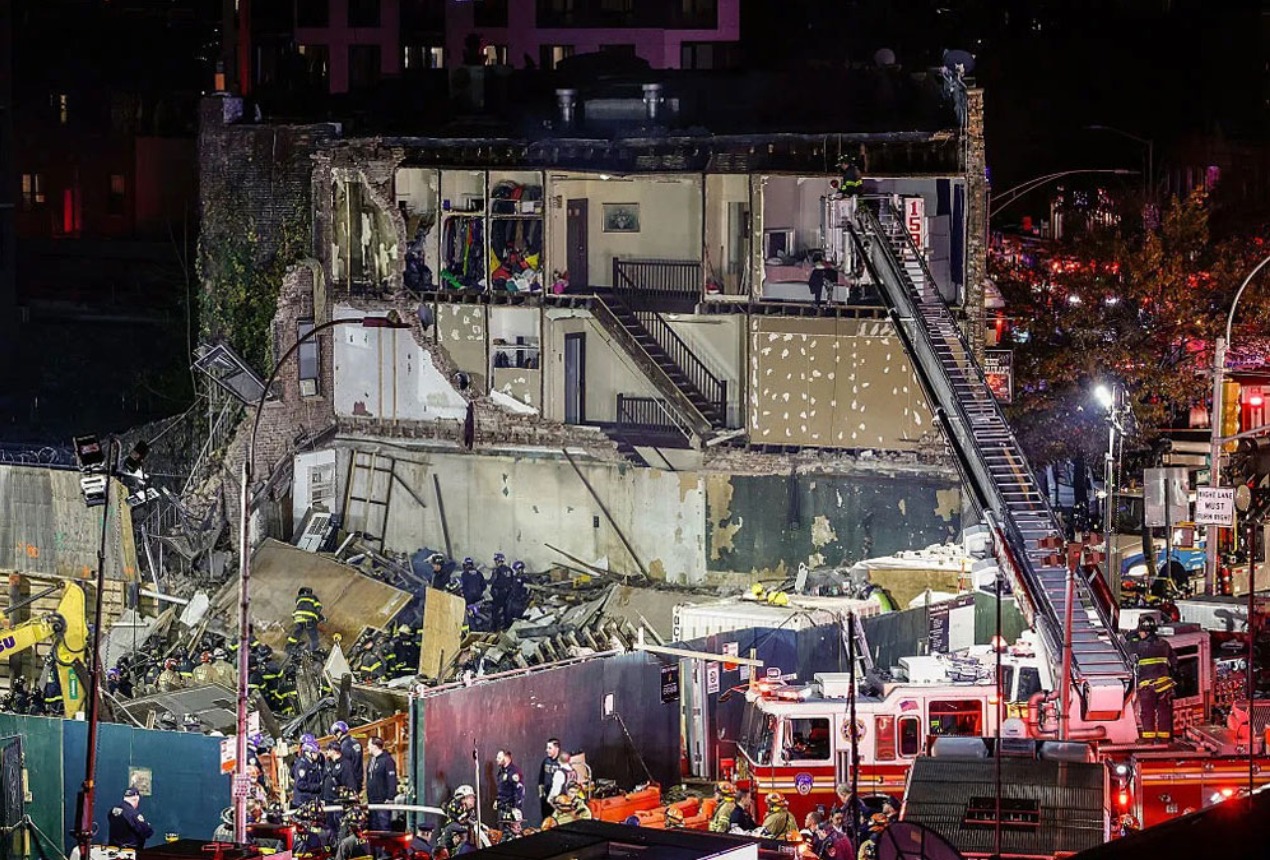
-In India- Assertion That Japan Bears Responsibility for Deterioration of China-Japan Relations A Chinese Foreign Ministry spokesman asserted at a press conference on the 12th that Japan bears full responsibility for the deterioration of China-Japan relations. In connection with the recent voices raised in Japan criticizing the authorities for evading historical responsibility and pursuing an unjust policy toward China, the spokesman denounced that the wrong view of history of the Japanese authorities is seriously destroying the political foundation of China-Japan relations. Saying that the responsibility lies entirely with Japan, he stressed that China strongly demands that the Japanese authorities sincerely reflect on and correct their mistakes on the Taiwan issue, historical issues and others. [KCNA] Bomb-Attack Threat Incidents On the 12th bomb-attack threat incidents against schools occurred in France. As a result, an uproar ensued in which teachers and students of the schools concerned were urgently evacuated. On the same day bomb-attack threat incidents against schools occurred again in various regions of Italy, creating great social unease and fear. [KCNA] Earthquake The Kamchatka Branch of the Geophysical Service of the Russian Academy of Sciences announced on the 12th that an earthquake measuring 5.4 on the Richter scale was observed in Kamchatka Krai, Russia. The epicenter was said to be 324 km from Petropavlovsk-Kamchatsky. [KCNA] Data on Geomagnetic Storms From November 16 to 30, 2026, there are no days on which a geomagnetic storm is predicted, and on the 17th, 27th and 28th there may be a perturbing action of the magnetosphere. Building Collapse Accident In New York City, USA, on the 11th a three-story building near a construction site collapsed, killing eight people and wounding 17. An official said that it is not known how many people are inside the collapsed building or how many are missing. [KCNA]
Method for Effectively Utilizing Fallen Leaves Before raking up and discarding fallen leaves, one should think of ways to utilize them effectively. - Mix them into the compost heap. Fallen leaves are a very suitable material to mix into a compost heap. To make compost, various organic materials rich in carbon and nitrogen content are essential. From that perspective, fallen leaves are rich in carbon. If fallen leaves are mixed together with materials containing a lot of nitrogen, such as cut grass, compost can be made with a balanced content of various components. If these materials are piled up and well mixed, oxygen is added and the fermentation speed increases. Another way to make compost is to first dig a pit in the ground, put fallen leaves in it, cover it with soil and leave it for several months. After that, turn the soil over. To increase the fermentation speed, it is good to chop the fallen leaves in advance. If there is no shredder, a lawn mower can be used instead. - Use them to cover the ground and obtain a warming effect. Fallen leaves are also excellent as an insulating material. Using fallen leaves, autumn crops and perennial plants can be protected from the cold so that they do not freeze. Since the purpose is to protect from natural influences, fallen leaves must be spread in sufficient thickness. If fallen leaves are spread thickly on the ground where crops and the like are growing, the growth of weeds can also be prevented. - Prevent soil erosion. If a flower bed is left for a long time without planting anything, the soil is eroded and washed away by rain. If fallen leaves are spread thickly over the flower bed, such a phenomenon can be prevented and the growth of weeds can also be checked. - Make humus. Humus, simply put, is "composted fallen leaves". Compared with compost, humus takes a long time to complete. However, the method of making humus is much simpler than making compost and requires less effort. If fallen leaves are piled up to a height of about 90 cm and simply left for six months to a year, they become humus. The important point is to ensure sufficient moisture. Humus is made using only fallen leaves rich in carbon. Therefore, considering the nutrient status, one should not spread too much humus in the garden. However, humus improves the condition of the soil and increases its moisture retention. It also creates a good environment for earthworms and beneficial microorganisms to inhabit. [KCNA] | |
| Category: English | Views: 19 | | | |