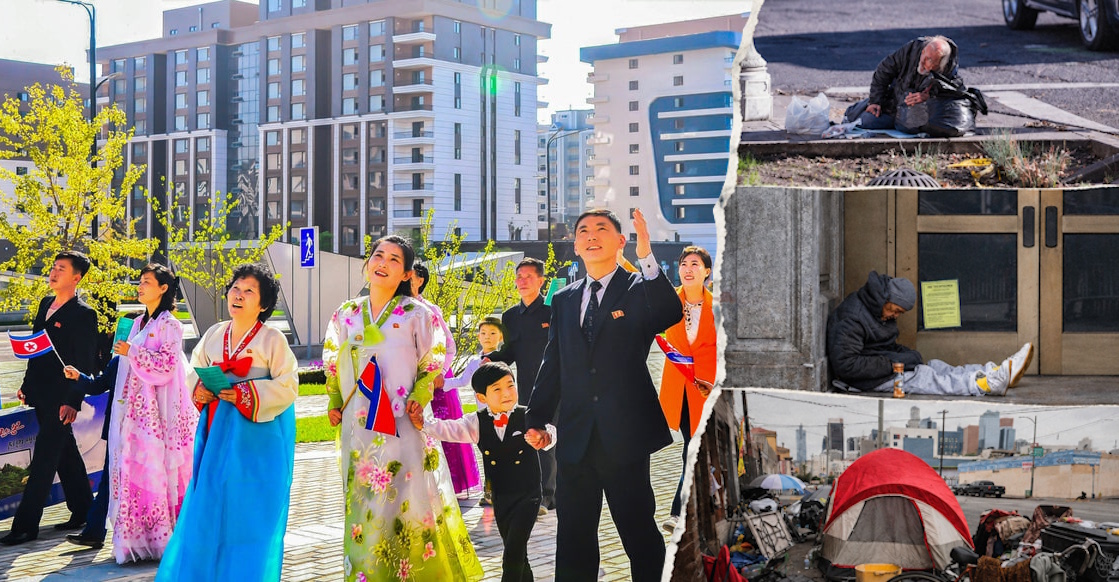
20:18 Stark Contrast Seen through the Housing Issue | |
November 7, Pyongyang (RSTV)
[조선어] [English] [Русский] [中国语]
The sixth page of the November 5, 2026 issue of Rodong Sinmun carried articles that sharply contrast the dreamlike reality in the socialist homeland where ordinary working people receive new homes free of charge with the actual situation in the capitalist countries where the homeless are overflowing and housing rents are soaring, making the social problem ever more serious. Their full text is introduced below. The Dreamlike World Where Ordinary Working People Receive Wonderful New Homes Free of Charge The respected Comrade Kim Jong Un said as follows. "We must as soon as possible provide our people, who have entrusted everything to the Party and have weathered all trials and hardships together with the Party, with a plentiful and happy life that leaves nothing to be desired in the world." There is a heart-warming scene unfolding everywhere in our country. It is the dreamlike reality in which ordinary working people receive wonderful new homes free of charge. That the state, devoting enormous efforts, builds numerous modern dwelling houses in the capital and the provinces and presents them to ordinary people is an amazing fact that exists only in our country's socialist system, which places the people most sacredly and foremost. The owners of the 80-story ultra-high-rise dwelling houses on Songhwa Street say with full hearts that they live in the highest dwelling house in the capital, in a workers' apartment. Indeed, in this apartment live workers of numerous factories and enterprises of the capital, including the Kim Jong Suk Pyongyang Textile Mill, the Kim Jong Suk Pyongyang Silk Mill, the Pyongyang Thermal Power Plant and the Pyongyang City Passenger Transport General Enterprise. There are dozens of working-class couples living here, and there are many households where the whole family are workers. Among them are also working-class couples who work at the Pyongyang Beer Factory and the Songyo Knitwear Factory. Until they moved into the new homes, they had looked at the splendid dwelling houses rising on Songhwa Street and wondered who on earth would live there. But before the fact that they themselves had spread their nests in the dwelling houses on Songhwa Street that they had so envied and looked upon, and moreover in the ultra-high-rise apartment highest in the capital, they could not hide their amazement. When they actually moved in, they found that not only their own families but almost all the households on Songhwa Street were ordinary working-class families. Ordinary working-class family—this appellation, heard everywhere, is today resounding with pride everywhere on Songhwa Street, in the Hwasong District and on the new streets of the capital. It is the reality of our country that ordinary working people live even in the best and finest dwelling houses in the capital. In the Hwasong District there are many apartments called by people the "multi-child neighbourhood". In the splendid new homes built with enormous state efforts so that the multi-child households feel not the slightest inconvenience in living, including the number and size of rooms, they are fully enjoying a happy life. How could it be only in the capital? According to compiled data, since the presentation of the new-era rural revolution programme, the modern new rural dwelling houses built in rural villages in various places amount to more than 113,000 households in over 1,860 villages of over 500 farms. In our country it is law that such splendid new dwelling houses are presented free of charge to ordinary working people including workers and peasants. The Construction Law and the Dwelling House Management Law explicitly stipulate that urban dwelling houses and rural cultural houses shall be built at state expense and that the principle of serving the people shall be firmly maintained in the allocation of dwelling houses. In this situation, a case arose in Munam-ri, Pujon County, where a single family received 12 dwelling house use permits, and among the citizens of the capital the number of families where parents, brothers and children all live on the new streets including the Hwasong District, Songhwa Street and Jonwi Street has increased beyond count. Where else but in my country could one find such a dreamlike reality, where even in the luxurious houses of Gyeongnudong that in capitalist countries only billionaires would use and live in, power plant workers, weavers, builders and road maintenance workers—such utterly ordinary people—live without even knowing the word "house price"? This is precisely our system, the best in the world, and our socialist home in which all the people are embraced. That is why all the people of the country value our socialist system more dearly than life, love it endlessly, and their hearts burn with the desire to repay it at every moment. "The only country in the world where the state builds dwelling houses with enormous efforts and presents them free of charge to ordinary working people is our country." Even at this very moment, in this voice resounding in every corner of the country are contained the boundless pride and happiness of the people living under the world's most superior socialist system, and their fiery oath to devote all their wisdom and passion for its sake. Yu Kwang Jin, staff reporter The Capitalist Bustling Streets Overflowing with the Homeless In the cities of the capitalist countries, too, bustling streets with brilliant lights flashing as if to flaunt "modern civilization" stretch out in all directions. The luxury restaurants, amusement places and service facilities lined up densely along the streets draw the eyes of passers-by. But when one looks beneath the shadow of that "modern civilization", a reality in stark contrast comes home. The number of people living in subway stations, sewers, tents or under bridges because they have no home is increasing exponentially. There are also people who dig caves in the mountains and live there. The fact that not a few of the homeless have jobs and regular incomes arouses even greater astonishment. Those who have attached themselves to houses of extremely small area or houses reminiscent of chicken coops may be said to be somewhat better off. Because they have no means to prepare their own homes, young men and women give up marriage, young couples do not want to have children, and later divorce—serious social problems are arising. Not long ago a public opinion survey was conducted in Japan in connection with the growing number of young people who do not wish to marry, and many respondents among single men and women aged 18 to 34 vented their discontent: "I have no intention of marrying for life. The problem of securing a dwelling house is becoming a barrier obstructing marriage." In Madrid, Spain, an 87-year-old woman was forcibly evicted from the rented house where she had lived for 70 years. With that as the occasion, a nationwide protest action demanding the solution of the housing problem took place in that country. In Portugal, too, fierce demonstrations took place protesting that housing prices had jumped by 200 percent since 2017. The situation is the same in any Western country. When one speaks of the housing crisis in capitalist society, it is by no means a crisis arising from an absolute shortage in the quantity of housing. Even on streets overflowing with vagrants there are many empty houses. According to published data, in a certain European country the homeless are increasing endlessly day by day, yet there are as many as one million empty dwelling houses. On the website of the World Economic Forum an article entitled "Housing prices are destroying our society" drew people's attention. The housing crisis of capitalism is in fact a price crisis brought about by house prices and taxes soaring to the heavens. In Paris, France, an ordinary house of 50 square metres costs 550,000 euros, and in US cities the average price of a medium-grade house reaches 1.3 to 1.4 million US dollars. The prices of luxury houses are so enormous that an ordinary family could never earn them even by struggling for a lifetime. In a writing by a European resident who had visited the US there is this passage. "There are very few skyscrapers in the cities where only a tiny number of people live. All the rest is a world of asbestos-board houses. "If we calculate the proportion, such high-rise buildings occupy 5 percent of the total city area, and the remaining 95 percent are backward asbestos-board houses full of filth and swarming with rats and cockroaches. The fact is exactly this." When a few rich people monopolize grand mansions, eat luxuriously and enjoy pleasure as the price of wickedly squeezing the blood and sweat of the broad working masses, hundreds of thousands and millions of people must roll on the bare ground because they have no space to shelter even their own bodies—this tragic reality, and the dramatic contrast in which vagrants swarm beneath splendid skyscrapers, is a vivid scale that directly shows the polarization of the rich getting richer and the poor getting poorer, which is deepening day by day in capitalist society. The source of this incomprehensible contradiction—vagrants and luxury houses—lies precisely in the capitalists' endless greed for profit. Even when building a single house, the capitalists think only of squeezing people's pockets, and calculate only how to multiply their property. Although they sit atop real estate worth hundreds of millions, they do not put out a single ear of a coin for building dwelling houses for the homeless who shiver on the streets. For capitalists, building houses for working people means wasting capital and signifies breaking with the law-of-the-jungle survival method of fighting for profit. In a certain country, although millions of households suffer from lack of housing, a tiny number of real estate owners possess hundreds of thousands of houses. A villa in a certain region of the US has been looking for a buyer since 2010 with its doors closed. Its price rises every year. Even if the villa remains unsold, the capitalist will never open its doors to the poor and the homeless. That the housing crisis in capitalist society is becoming ever more serious cannot be separated from government policy. Until now the governments of capitalist countries have put forward various measures while professing to resolve the dwelling house crisis. But in essence they are not for the working masses but for the capitalists. Many Western countries say they build various forms of lowest-price housing, but the prices are by no means at a level the broad masses can easily pay. So it is with the housing purchase systems implemented in the West. When a builder builds a house, a banker tempts one by lending most of the house price. When the house is sold in this way, the sale money goes into the builder's pocket, and the bank fills its coffers by receiving principal and interest from the buyers every year. The buyer must return the principal and interest to the bank and pay various taxes including house rent. In the end people are exploited doubly and triply, and later are driven into a situation where they must be expelled from their homes, crushed under a mountain of debt. The dwelling house policies implemented in the Western countries differ somewhat, but they are common in being capitalist-oriented policies. In capitalist society the housing problem only produces the result of increasingly oppressing the living conditions of the working masses while further fattening the moneybags of the rich. The capitalist bustling streets, where billboards of civilization and growth flash, are a living hell that forces only pain and death upon the working masses. Un Jong Chol Soaring Housing Rents The British newspaper The Guardian, saying that the soaring of housing rents in Europe is bringing about a serious social problem, asserted that the housing problem is even destroying the foundation of social relations. According to a report published by the Paris Region Institute of France, the average housing rent in Paris and its surrounding areas rose about 3.9 times for furnished housing and about 3.8 times for unfurnished housing from 1984 to 2020. On the other hand, per-household income showed little change during the same period. Housing rents dealt a greater blow to the low-income strata. Such households must spend nearly half of their monthly income on housing rent. The situation in the centre of the capital was more serious than in the surrounding areas. Last year the average housing rent in Paris was 27.3 euros per square metre. The Paris Region Institute predicted that high housing rents could go beyond individual living problems and affect the economic development of the capital and surrounding areas. It expressed serious concern that housing rents are soaring to a level increasingly difficult for many people to bear. Staff reporter An Unattainable Wish On July 29, 2024, the US newspaper The Washington Post carried an article entitled "No Home Even with a Job: The Growing Number of Homeless in the US". The content of the article is as follows. According to a survey, in many regions of the US the number of homeless wanderers is increasing noticeably; in southeastern Texas the number of homeless increased by 61 percent compared with last year, in Rhode Island by 35 percent and in northeastern Tennessee by 20 percent. It is said that a quarter of Americans who rent a house spend more than half of their income on rent and the like, and as a result the risk of being thrown onto the street because they cannot cover the rent continues to rise day by day. A person working at a certain bakery says he sleeps in a park after finishing his shift every day. He said: "There are times when you get so tired of it. You want to snack on something but... for what I really want: to sleep in a bed again." … Everyone wants to have their own home, but in capitalist society that is an unattainable wish. Staff reporter | |
| Category: English | Views: 55 | | | |