18:40 International News in DPRK Media (May 24, 2026) | |
May 24, Pyongyang (RSTV)
[조선어] [English] [Русский] [中国语]
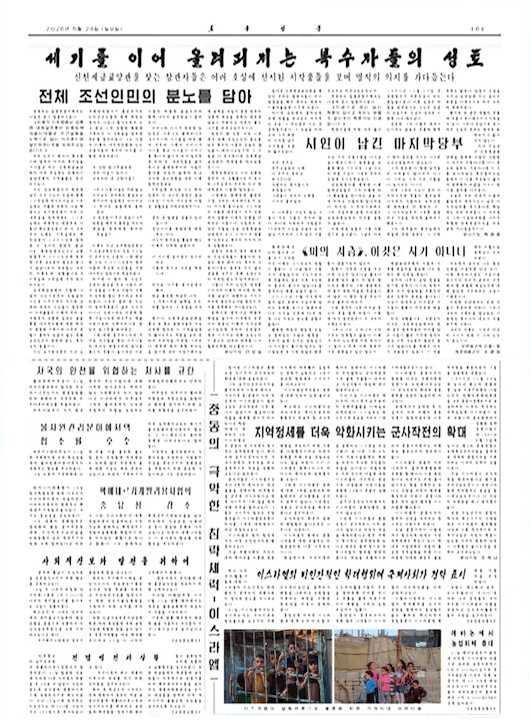
The international news carried on Page 6 of Rodong Sinmun dated May 24, 2026, reports on the denunciations of avengers resounding at the Sinchon Class Education Hall, the condemnation of Lithuania by Belarus, the appeal for global cooperation in water resource management, the importance of peaceful nuclear energy development and utilization in Africa, cooperation between China and Vietnam, the development of information technology in Uzbekistan, water supply projects in Cambodia, the spread of the Ebola epidemic, the expansion of Israeli military operations and inhumane abuses, and the resulting agricultural damage in Lebanon. The full text follows: Denunciations of Avengers Resounding through the Centuries Carrying the Anger of All the Korean People The respected Comrade Kim Jong Un said as follows: “The mass killing atrocities committed by the US imperialists in Sinchon show that the US imperialist aggressors are cannibals and murderers who take delight in human slaughter.” In several rooms of the Sinchon Class Education Hall, which our people visit year after year to steel their will to destroy the enemy and their vengeful spirit, poems on the theme of anti-imperialist and anti-US education are also displayed. The last poem left by poet Kang Sung Han is displayed in Room No. 12 together with his portrait; in Room No. 3, the poem “Death to the Enemy” written by revolutionary poet Cho Ki Chon during the days of fierce war; in Room No. 11, the poem “Song of Curse” by the world-famous literary giant Paek In Jun; in Room No. 5, the poem “Your Life Is Over” created by Paek Ha in 1960; and the sequels to the poem cycle “The Reckoning of Sinchon Is Not Over” created in 2008 by Comrade Jo Kwang Won, a special-class honoured disabled soldier and poet, namely “Strata of Blood” and “Blood Ties”, are exhibited in Room No. 6 and Room No. 9 respectively. These poems, created by poets of different years and generations ranging from the poet of the fierce days of the Fatherland Liberation War to the poet of today, are vivid records of history about the bestial atrocities that would make even beasts blush, perpetrated by the US imperialists on our homeland, and an eruption of the grudge, anger and vengeful spirit of all the Korean people that can never be forgotten no matter how much time passes. Poet Cho Ki Chon, who went to the very front lines together with soldiers of the People's Army as a war correspondent during the Fatherland Liberation War, created the poem “Death to the Enemy” on the basis of the intense experiences he saw, heard and felt. In the poem, he expressed the bestial atrocities of the US imperialists and the vengeful will of the soldiers of the People's Army as follows: There was a small village beneath the mountain During the Fatherland Liberation War, the US imperialists massacred more than 35 000 patriots and innocent people – one-fourth of the soldiers and civilians – in Sinchon County alone during 52 days of occupation in the most bestial manner. That is why a poet of this land expressed that Sinchon is a place where human blood formed rivers and human corpses piled up like mountains. This is by no means a poetic phrase born of a poet's creative excitement. Along with the name Sinchon, the heartbreaking Children's Grave of a Hundred and Two, the Mothers' Grave of Four Hundred, the powder magazine at the chestnut grove in Wonam-ri – when thinking of them, one hears the heart-rending cries of mothers searching for their beloved children, the desperate wails of children crying their hearts out looking for their mothers, and the howling of beasts. It is so happy for a mother and child to be together, said the US imperialist aggressor officer who issued the atrocious murder order: “Lock up the mothers and children separately. Let the mothers search for their children and the children search for their mothers until they starve and die with their blood dried up.” “Starve them to death, burn them to death. Exterminate the human seed altogether.” The poem “Your Life Is Over” by poet Paek Ha, displayed in Room No. 5, condemns and denounces the beastliness, viciousness and cunning of this fellow. Do you dare think you can hide your face, The visitors who go to the Sinchon Class Education Hall year after year cannot suppress their boiling indignation before these poems created decades ago, and clench their fists tightly. It is because they want to lay bare before the world the true colours and inner thoughts of the enemy who, knowing his crimes are unpardonable for all ages, dared not show his face before the camera lens, and to pour upon him a shower of curses. Sinchon, the land of grudge – it is here that poems of vengeance carrying the anger of all the Korean people are ceaselessly born even today, and if all those poems were to be displayed, the walls of the Sinchon Class Education Hall would overflow with them. A university student whom we met in Room No. 9, where the poem “Blood Ties” by special-class honoured disabled soldier poet Jo Kwang Won is displayed, said as follows: I have a collection of poems, “Blood for Blood!”, published a few years ago. Most of the over 70 poems in it are poems condemning the atrocities committed by the US imperialists here in Sinchon. Seeing today at the Sinchon Class Education Hall the poems I saw in the collection, their meaning comes to me anew, and my will for vengeance grows more intense. Although decades have passed since the war flames ceased, each poem of vengeance that continues to be born today carries the surging anger of all the Korean people that will never cool and never be appeased. Indeed. Our people, generation after generation, are unearthing the crime-filled history of the US imperialists one by one and redoubling a thousandfold their will to destroy the enemy, determined to settle the score with blood without fail. As long as the US imperialists – the root cause of all evils that emerged through aggression, swollen with plunder – remain on this earth, our march to Sinchon will continue, and the anger of all the Korean people will blaze like an active volcano through the years and generations. Staff Reporter An Song Il The Last Request a Poet Left Behind Not long ago, while visiting the Sinchon Class Education Hall, we came upon a work of art before which visitors could not easily take their leave. The figure of a man gripping a pencil with his bound hands in a freezing cell – the subject was poet Kang Sung Han. Looking at that figure, we quietly recited the verses he left at the final moment. … In this country, there are many poets and countless poems they have written. Then why do people still remember a poet from 76 years ago and recite the poem he left by heart, over and over? The respected Comrade Kim Jong Un said as follows: “The road walked with faith is the road of revolution, and a revolutionary's faith is what cannot be abandoned even in death.” As we savoured the lines of the poem we used to memorise and often recite in our schooldays, the indomitable spirit of the poet on that day 76 years ago, which made the enemy tremble, seemed to appear before our very eyes. The US imperialist aggressors who arrested Kang Sung Han viciously struggled to make him write something praising them, by whatever means. But nothing could bend his will as a member of the Workers' Party of Korea, firmly rooted in his heart. Maddened with spite, they dragged him out to the execution ground. That day was October 17, 1950 – Kang Sung Han's thirty-second birthday. Though his heart stopped beating, the poet was reborn on this land in the image of eternal life, a strong man of faith. Kang Sung Han – his name, together with the valued title of patriotic poet, is known even to young schoolchildren, to say nothing of the citizens of this land. It is not because he left many poems while alive. Nor is it because everyone knows all his poems. It is precisely because that single poem the poet engraved on the beloved mountains and rivers of the homeland as he faced the enemy's guns at the last moment of his life – that last request – is so earnest and so powerfully stirs the heart. Before the enemy's guns, he had no fear of death, no regret whatsoever. He was rather proud to have guarded the faith of a Party member and fulfilled the duty of a citizen before the homeland. Writing done with a pen may fade or be erased with the passage of time. But the expression of faith engraved with all one's soul will never lose colour or vanish. Over the past decades, countless people who have visited the Sinchon Class Education Hall have engraved this poem in their notebooks – nay, in their hearts that pound with hatred – and at meetings of vengeful resolve have recited this poem with heightened emotion, steeling their determination to exact a thousandfold price of blood without fail. Today our generation has engraved the last request left by the patriotic poet before the work of art; tomorrow our future generations will stand at this very spot and commune with him in their hearts, steeling their thoroughgoing anti-imperialist class consciousness more firmly. Staff Reporter Paek Kwang Myong “Strata of Blood” – This Is Not Poetry It has now been over 20 years since I began writing poetry as a special-class honoured disabled soldier. Though I have produced many poems over those days, I cannot forget the time when I created the poem cycle “The Reckoning of Sinchon Is Not Over”, which is like a first work for me as a poet. In May 2007, upon learning from the newspapers and TV that scores of remains had been unearthed once again not far from the capital, I could not contain my surging anger. Beneath the land of this happy paradise, countless souls are still buried today – and who knows how many other sorrowful souls are asleep under the park paths we always tread or under the lawns where children love to roll about?… One poet said of Sinchon, steeped in grudge, that it is a land where the earth placed on the graves is more than the earth we tread upon – yet what should we call this land, where there are even more unjustly lost lives that could not even enter such graves? Such thoughts made me take up the brush of anger. Thus was created the poem “Strata of Blood”. But I could not be satisfied with just that one poem. How great are the crimes the US imperialists have inflicted upon our people – how could they be concluded with a single poem? Determined to bind a poem cycle with poems on the theme of class education, I visited Sinchon, the land of grudge. As I toured the places of Sinchon, where even the roadside trees, if their bark were freshly peeled, would seem to drip not sap but red blood of grudge drop by drop, poetic inspiration flashed like lightning and poetic words like daggers welled up in my head one after another. Thus, poems carrying the will to annihilate the enemy, such as “Blood Ties”, “Short Poems of Hatred” and “Before the Boundary Line”, were created in a short period, and the poem cycle “The Reckoning of Sinchon Is Not Over” was produced in less than a year. This work was awarded the June 4 Literary Prize. Though I live in the capital, I always carry Sinchon in my heart. For although it is a heartbreaking place to recall, it is a place that truly teaches us about the thoroughgoing class consciousness we must firmly cherish. All manner of plants grow luxuriantly in fertile soil. But on this land where the “strata of blood” lie, the ranks of avengers grow formidably. “Strata of Blood” – this, before being simply poetry, is the anger of the people of this country. Jo Kwang Won, Special-Class Honoured Disabled Soldier, Inhung 1-dong, Moranbong District Act Threatening Own Country's Security Condemned On the 21st, the Ministry of Foreign Affairs of Belarus summoned the Chargé d'Affaires ad interim of Lithuania in connection with the violation of Belarusian airspace by a Ukrainian drone launched from Lithuanian territory. Denouncing that the Lithuanian authorities took no measures to prevent the drone launch from their territory nor gave any prior notification, the Foreign Ministry branded it a violation of international law that creates a direct threat to the security of Belarus. The Foreign Ministry demanded that Lithuania take measures to prevent acts that violate the airspace and border security of Belarus. (Korean Central News Agency) Cooperation in Water Resource Management Called For In a video speech sent to an international conference on the 20th, the Minister of Foreign Affairs of Tajikistan called for global cooperation in the field of water resource management. He noted that while humankind faces challenges such as floods, droughts, water shortages and water pollution caused by climate change, the demand for water in many sectors is continuously growing, and said that in the current period when the climate crisis is deepening further, cooperation in water resource management is emerging as a more urgent issue than ever before. He stressed that sustainable water resource management is an important undertaking for ensuring food security, improving people's health and promoting economic growth. (Korean Central News Agency) Importance of Nuclear Energy Development and Utilization Underscored In a speech at an African summit on nuclear power on the 19th, the President of Tanzania stressed the importance of the peaceful development and utilization of nuclear energy in Africa. He said that the continent's economic development largely depends on energy resources that can underpin industrialization, mining, the modernization of transport and the construction of water infrastructure, and noted that this summit would serve as a meaningful gathering to establish a reliable and sustainable peaceful nuclear energy development and utilization system on a continental scale. He called on the countries of the continent to strengthen cooperation in this field, noting that the securing of funds and the training of personnel are important issues in ensuring the peaceful development and utilization of nuclear energy. (Korean Central News Agency) For Social Progress and Development - China and Vietnam are strengthening cooperation to protect and increase fishery resources. - Uzbekistan is directing efforts to the development of information technology. - Cambodia is working to improve the water supply service for residents. (Korean Central News Agency) Status of Epidemic Spread - An Ebola virus case has occurred in South Kivu Province of the Democratic Republic of the Congo. According to data released on the 21st, a 28-year-old man who had travelled from another region died, and test results confirmed that he was infected with the Ebola virus. Since the 15th, the nationwide number of infections has reportedly increased to about 750, and the number of deaths to 177. - Uganda has recently taken measures to prevent the spread of the Ebola virus. (Korean Central News Agency) Israel – the Most Vicious Aggressive Force in the Middle East Expansion of Military Operations Further Aggravating the Regional Situation Not long ago, Israeli army Chief of General Staff Zamir talked about expanding military operations. While touring the West Bank area, he asserted that the military operations the Israeli army is conducting on multiple fronts in the Middle East, including Iran, Lebanon and the Gaza Strip, are not yet over and that it is ready to resume fighting if necessary. He went on to say that the Israeli army is on a constant offensive posture in all parts of the Middle East, and is conducting operations offensively while holding the initiative in Lebanon, the West Bank and the Gaza Strip. Analysts are drawing attention to the fact that Zamir made such remarks after Israeli Prime Minister Netanyahu instructed the military to strike targets in Lebanon heavily. They maintain that Zamir's remarks are nothing but a faithful representation of the will of the Israeli ruling circles. Israel is behaving ever more arrogantly from the standpoint of force. Now the international community hopes that a substantive ceasefire will be realized as soon as possible in the Gaza Strip, Lebanon and other parts of the Middle East and that it will lead to a firm peace. Israeli authorities also frequently speak of a ceasefire. Recently, Israeli Prime Minister Netanyahu said that he would create an opportunity to pursue a comprehensive diplomatic and military solution with the Lebanese government, and spoke of extending a hand for peace. Israel has already reached ceasefire agreements with the Palestinian Hamas and with Lebanon. Yet while Israel talks so noisily about a ceasefire, it has not halted its military actions for a moment. This time it has openly proclaimed that it will expand military operations. It is all too obvious that expanding military operations is incompatible with a ceasefire. Israel's behaviour is nothing but blatant threats and blackmail against Middle Eastern countries. In reality, in the Gaza Strip, Lebanon and elsewhere, numerous buildings are being destroyed and casualties are occurring daily due to Israel's indiscriminate military attacks. On the 6th, Israel struck residential buildings in the southern suburbs of Beirut, Lebanon, with missiles. On the 10th, it bombed a small town, killing one person and wounding 13. It also bombed medical facilities in two other small towns, taking the lives of innocent residents. A few days ago, 29 people, including women and children, were brutally killed in Israel's bestial air strikes on several cities and villages. In the West Bank, too, Israel's slaughter atrocities continue without end. This time, the statement by the Israeli army Chief of General Staff that military operations are not yet over and that fighting will be resumed, and that the armed forces are on a constant offensive posture, is akin to a naked revelation of the hidden intention to swallow the territories of neighbouring countries by force. Israel is openly challenging the international community that desires peace in the Middle East. By expanding military operations, it is trying to completely strangle Middle East peace. Since the creation of the Jewish state, several Middle East wars have broken out, and because of this, the sound of guns has never ceased in the Middle East at any time. Every time Israel concluded a ceasefire after a physical clash with various Middle Eastern countries, it professed to welcome it, but then sat back, accumulated strength, and again provoked and expanded its territory. Not a few Middle Eastern countries have lost territory to Israel. Israel has become a constant source of destruction of peace and security in the Middle East region. The Western forces also bear responsibility for the Middle East region having become so dire. Throughout history, the Western forces, in order to realize their sinister objectives, have provided Israel with massive financial and material support and driven it into war. The Second Middle East War, also known as the Suez War, which broke out on October 29, 1956, was also a war of aggression perpetrated by Israel in collusion with Britain and France under the active instigation of the United States, which sought to stifle the Arab people's anti-imperialist national liberation struggle with its “big stick policy”. The Third Middle East War, which broke out on June 5, 1967, was also a product of the US strategy of putting Zionist restorationists forward as a shock brigade to dominate the Middle East region. Both the mad frenzy with which Israel is now proclaiming the expansion of military operations and its indiscriminate air strikes on neighbouring countries are unthinkable apart from Western backing. The decades-long history of the Middle East and the recent developments clearly show that as long as Israel's ambition for territorial expansion and the Western machinations that actively encourage it persist, peace and security in the region cannot be achieved. Staff Reporter Ri Hak Nam International Society Expresses Shock at Israel's Inhumane Abuses Recently, Israel's inhumane abuses against humanitarian activists have been made public, arousing the shock and anger of the international community. On the 21st, the person called Israel's National Security Minister brazenly released a video footage showing the process of attacking an international humanitarian convoy that was carrying aid goods to the Gaza Strip, seizing the vessels and detaining the crew members. According to the video footage, the Israeli Zionist restorationists, with their hands bound, forced the humanitarian activists to bow their heads and kneel, and even inflicted severe injuries by assaulting them. As soon as the video footage was released, many countries of the world are denouncing and condemning Israel's bestial atrocities. The Italian government branded Israel's abusive acts as an intolerable act that violates human dignity and argued that the European Union should impose sanctions on Israel. The governments of France, Spain, the United Kingdom, Australia, Canada and many other countries also condemned Israel's most vicious atrocities and demanded the release of the humanitarian activists. (Korean Central News Agency) Agricultural Damage Increases in Lebanon On the 21st, the Lebanese government announced that the area of agricultural land destroyed by Israel's atrocities has increased to more than 56 000 hectares, which is equivalent to about 22.5% of the total agricultural land. Agricultural infrastructure has been destroyed, and the total damage amounts to over 530 million US dollars. (Korean Central News Agency) | |
| Category: English | Views: 138 | | | |