17:17 Let Us Possess a More Thoroughgoing Anti-Imperialist Class Consciousness as Generations Change and the Revolution Advances | |
August 2, Pyongyang (Rodong Sinmun - RSTV)
[조선어] [English] [Русский] [中国语]
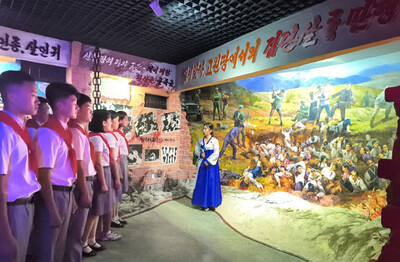
Looking at the Materials Displayed at the Kowon County Class Education Hall With Surging Hatred for the Enemy The respected Comrade Kim Jong Un said as follows: “Our great Fatherland Liberation War clearly showed what amazing miracles are created when simple and ordinary people, defending their own things, rise up unafraid of even death.” During the period of the strategic temporary retreat in the past Fatherland Liberation War, the US imperialist enemies who had crept into Kowon County brutally massacred hundreds of people during over 50 days of occupation. On one pass in today's Jonthan-ri alone, the bastards committed the beastly atrocity of collectively burying alive as many as 130 innocent people. The crimes of the enemies, who indiscriminately slaughtered without distinguishing even women and children, triggered a total explosion of the surging hatred of the people of Kowon County towards the US imperialist aggressors. Those who engraved even more deeply in their hearts the preciousness of the fatherland restored by the great Leader during the period of stern trials rose up as one in the struggle to destroy the enemies who had crept into their native land. One of the representative struggles is precisely the activity of the Kowon People's Guerrilla Unit that fought bravely against the US imperialists and the class enemies. The guerrilla unit, which was organized with over a hundred Party members and patriotic people in October 1950, was strengthened into a force of several hundred in the course of battles. As Kowon County is located in an area advantageous for railway transport, it became one of the main operation points of the US imperialist aggressors at that time. The guerrillas, establishing their base in the mountainous area and conducting activities, powerfully aroused all the people in the county to the annihilation of the enemy. They set up four defensive lines from Kowon to the Pyongwon Line area and conducted bold battles to repulse the enemy's attacks, raided enemy military trains in the Yangdok and Kocha directions, and blew up railway bridges and tunnels, thereby foiling the enemy's scheme to ensure transport between the eastern and western parts of the front. And they printed propaganda writings titled “Partisan Communications”, “Battalion Communications” and “Advance”, and scattered leaflets saying “The People's Army Will Return” and “Give Death to the US Imperialist Aggressors!” everywhere, giving the people confidence in victory. In those days, the guerrilla unit killed and wounded a large number of enemies and achieved brilliant battle results by liberating many areas including the seat of Kowon County in contact with the People's Army. Among the ranks of the patriots who fought to defend their hometown with blood were also young boys. They were precisely the members of the Young Guards including the boy So Kang Ryom who is widely known throughout the country. The Kowon Young Guards scattered leaflets, appeals and proclamations containing such contents as “Do not be deceived by the enemy's deceptive propaganda!”, set up explosives at the enemy's dens and annihilated many enemies, and cut communication lines, thus foiling communication connections. Even at the last moment when he was arrested by the enemies and met his end, the boy So Kang Ryom made the enemies tremble by loudly shouting “Long live General Kim Il Sung!” The struggle of the preceding generations who fought bravely for the beloved fatherland and native land is strongly touching the heartstrings of the new generations who visit the Kowon County Class Education Hall even today. Among them are also the students of So Kang Ryom Senior Middle School in Kowon County, which is named after the boy martyr So Kang Ryom. The principal of this school, whom we met, told us the following story, saying that the zeal among the students to grow up into reliable defenders of the socialist fatherland and true masters of the native land by learning from the ardent patriotism of the boy martyr and his resolute fighting spirit against the class enemies is rising day by day. The school organizes a contest every year to enhance the students' writing ability, and most of the works that received excellent evaluations there are works dealing with the struggle of the boy So Kang Ryom. A graduating class student who expressed his determination to become a true son of the fatherland like the boy So Kang Ryom in a writing titled “Son of the Tokji River”, upon receiving the university admission notice, readily volunteered for the People's Army. Like him, many graduates of the school are keeping their pledges to be proud before the martyrs not merely inscribed in the lines of their writings but put into practice. Listening to the principal's story, we pictured the proud appearance of the new generations who are growing up day by day, learning from the noble spiritual world of the preceding generations who engraved clear traces in the great history of victory and on the native land with indomitable struggle and bravery. Even as generations change and time passes, the thoroughgoing spirit of defending the fatherland and the resolute class consciousness possessed by the preceding generations are being carried forward even more firmly and steadfastly. If the US imperialists again bring the dark clouds of war to this land, we will rise up like a mountain and beat the enemies to death at a single blow. Text and photos: Pak Sol Rim The Song of Faith That Rings Out Even Today The respected Comrade Kim Jong Un said as follows: “Only those who firmly cherish revolutionary faith can walk the road of revolution to the end and be proud before the fatherland and the people.” Even today, there is a story about a martyr woman that the people of Kowon County cannot forget and keep passing down. It was an event that occurred in a certain ri of Kowon County during the period of the strategic temporary retreat in the past Fatherland Liberation War. Comrade Pang Rak Gu, who was in charge of the rehabilitation work of the ri, and his daughter, the woman Pang Sun Hui, who worked as the chairwoman of the ri women's union, were arrested by the enemies who were rampaging wildly on a mad hunt for people at a road junction, as they were heading late to the assembly point after finishing their assigned tasks. The US imperialists and the class enemies, rejoicing that they had caught the wicked red father and daughter, dragged them to their den. Gazing at the bastards with eyes full of hatred who demanded them to tell where the Party members were hiding, they uttered not a single word. To break their faith that would not yield to any appeasement or deception, the enemies continuously inflicted fiendish tortures that transcended human imagination. The bastards approached the woman Pang Sun Hui, who was known in the village as a “nightingale”, and prattled with a broad grin that since she was so good at singing the songs of the Republic, she should sing their songs just once, then they would spare her life. Then the woman Pang Sun Hui shouted at the bastards, asking if they thought she could not sing when told to sing, and sang the “Song of Ploughing” that she had sung joyfully while farming on the land distributed after liberation. Following her, the father also vigorously sang that memorable song together with his daughter. At that moment, the unforgettable days of the five years after liberation, when they had enjoyed dreamlike happiness singing the “Song of Ploughing” on the land of the fatherland restored by the great Leader, flashed before their eyes like a kaleidoscope. Comrade Pang Rak Gu had always lived with the sorrow of not being able to buy a single set of clothes for his beloved daughter because they were so poor before liberation, and the woman Pang Sun Hui had not even been able to go near a school gate because she had no money, even though she wanted to learn. Only after liberation did they finally come to enjoy a true human life, and the father and daughter, who were ordinary peasants, were able to grow up into officials undertaking the work of the ri thanks to the benevolence of the country. When the villagers affectionately called them devoted father and daughter, seeing them run about day and night for the ri work, they did not know fatigue even as they worked on and on. When nothing could break their faith in the Republic, which they cherished dearly in their hearts, the maddened bastards stood the father and daughter on top of an embankment and raved that they would forgive them if they now sang their songs. But from them, the “Song of Ploughing” still rang out. The song of faith they sang until the last moment of their breath made the enemies tremble. The singing of the martyr father and daughter, who fought unyieldingly even before the fiendish atrocities of the US imperialist beasts, is deeply engraving what revolutionary faith is and how it should be kept, and is ringing out even today. Staff Reporter The Grudge Imbued in the Tokji River In those stern days of 1950, the blood of patriots and innocent people who were brutally massacred by the US imperialists and the class enemies also flowed into the Tokji River winding around Kowon County. The US imperialists and the class enemies who had crept into Kowon County during the period of the strategic temporary retreat in the Fatherland Liberation War viciously murdered innocent people wherever they went, and on the Tokji River alone, they committed countless atrocities that invoke the wrath of heaven. The US imperialist beasts, who sat on the Tokji River bridge where many people passed and committed all kinds of evil acts against people, were bloodthirsty wolves who took delight in human slaughter. The bastards dragged out a large number of people of Kowon County to the banks of the Tokji River and massacred them by showering them with bullets. Therefore, the sound of gunfire and the groaning of people never ceased under the Tokji River railway bridge, and this river, where the happy laughter of people had overflowed, turned into a river of grudge and a river of anger within a few days of occupation. In January 2008, an unexploded bomb dropped by the US imperialist aggressors during the past Fatherland Liberation War was discovered at the construction site of the Tokji River bridge, making the officials, Party members and workers of the county seethe with boundless hatred and hostility towards the US imperialist enemies. The unexploded bomb discovered at the Tokji River bridge, which everyone had crossed mindlessly many years after the days of the war, once again reminded people of the history of grudge imbued in the Tokji River. The unexploded bomb dismantled at that time is now displayed at the Kowon County Class Education Hall. Looking at the atrocities of slaughter committed by the US imperialists on the Tokji River and the unexploded bomb discovered at the Tokji River bridge, the visitors are becoming aware that even the river water winding around their native land is imbued with a grudge that must never be forgotten. The bloody outcry that rang out from the Tokji River over 70 years ago is still steeling our will for revenge against the US imperialists and the class enemies even today. Staff Reporter | |
| Category: English | Views: 97 | | | |