21:00 International News in DPRK (October 29, 2026) | |
October 29, Pyongyang (RSTV)
[조선어] [English] [Русский] [中国语]
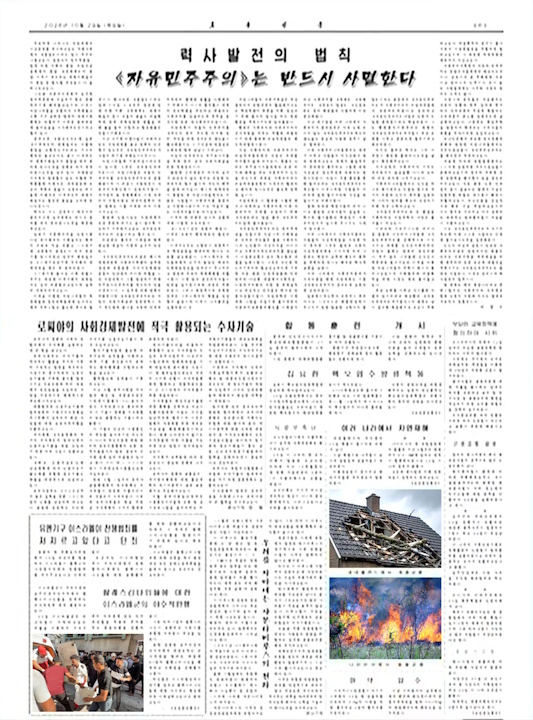
The third and sixth pages of the October 29, 2026 issue of Rodong Sinmun carried the news that our country's athlete Pak Myong Jin won the championship with a world record at the World Championships of the International Weightlifting Federation; an editorial asserting the demise of "liberal democracy"; an article on digital technology actively employed in Russia's socio-economic development; concern over the spread of the Shamonda virus; news of the start of joint army counter-terrorism exercises between China and Indonesia; condemnation of Japan's persistent scheme to discharge nuclear-contaminated water; Australia's food shortage; natural disasters and drug seizures in various countries; the condemnation by UN bodies of Israel's war crimes and the exposure of its atrocities against the Palestinians; a protest in Austria against the education policy; news of casualties in Mali, Jordan and India; and news of Ebola casualties in Kenya. News of the 2026 World Championships of the International Weightlifting Federation Our Athlete Pak Myong Jin Wins the Honoured Championship Our country's athlete Pak Myong Jin won the honoured championship in the men's 65 kg category at the 2026 World Championships of the International Weightlifting Federation. In the competition held on the 28th he lifted 144 kg in the snatch and 187 kg (world record) in the clean and jerk, for a total of 331 kg (world record), thereby taking first place in the clean and jerk and in the total and winning two gold medals. [Korean Central News Agency] The Law of Historical Development: "Liberal Democracy" Is Bound to Perish In the international community, which is watching with grave concern the morbid symptoms appearing in the Western world, the word "end" is circulating in countless forms. All sorts of assertions are being voiced—the political end of those in power, the end of rule by law, the end of the Western-style financial system, the end of "globalization", the end of the US-led world domination order. This may be said to indicate that the capitalist world has sunk into serious political confusion and an economic crisis hard to remedy, and that the world domination system of greed, which the US built up by rallying the Western countries and consolidated over a long period, has also entered an irreversible course of collapse. Even from the mere title of the article "How Will the US-led World Order Come to an End?", carried in the Chinese newspaper Cankao Xiaoxi, one may see that the piece unfolds on the premise that the US-led world domination order cannot escape its end. Whether through a fierce armed conflict that may break out in the Western Pacific region, or through the crises endlessly generated by the intensification of internal conflicts and contradictions, the US-led world domination order is bound to come to an end. History confirms that, no matter which great power dominated it, a unipolar world has invariably been unable to escape collapse. The domination order of the Roman Empire, which once supposedly stabilized the Mediterranean region, came to a close with the decline of the empire, and the hegemonic order of Britain, which became the "workshop of the world" and reached its prime in the 19th century, collapsed after two world wars in the first half of the 20th century. In the course of the years since the beginning of the 21st century, the world order of US domination has also been severely shaken and is rapidly weakening. For the monopoly conglomerates and ruling forces of the US and the other Western countries this will be a most worrisome and unsettling trend. For all those things connected with the word "end"—rule by regime and by law, "globalization", the world domination order—are precisely what they have painstakingly established and formed for their endless profit, power and luxurious, dissolute living. With regard to the Western world, which is declining beyond comparison with former times, what can be unequivocally asserted is that "liberal democracy" stands in peril of demise. If the Western countries have a basic ideology, it is "liberal democracy". The Western countries have whitewashed their democracy as "liberal democracy" and have propagandized as though the capitalist society were the embodiment of this ideology. Their state political and economic systems have been established on this basis, and the drafting and legalization of domestic and foreign policies are likewise carried out on this foundation. All the confusion and crises of the Western world that border on the end may be said to be the product of "liberal democracy", which is becoming ever more difficult to function day by day. In an ideology there are thoroughly reflected the character of the times and, together with it, the aspirations and demands of the corresponding class. The ideology of "liberal democracy" was manufactured by the Western forces, who felt a great threat in the rapid growth of the socialist forces and the upsurge of the working-class movement and the colonial national-liberation movement after the Second World War, by distorting bourgeois democracy in order to obliterate it. To lay bare its character clearly: "liberal democracy" is not something the Western capitalist class and ruling forces devised in order to provide their own people with true freedom, democratic rights and a happy life, but an utterly vicious anti-communist, anti-socialist ideology whose purpose lies through and through in strangling socialism, which leads and represents the progressive forces of the world. Although the Western forces have ceaselessly advertised their democracy as "politics of the people, politics based on the people, politics for the people", its deceptiveness and reactionary nature were exposed in every detail long ago. Western democracy is politics for the bourgeoisie, a dictatorial politics for the pure capitalist class. Politics that do not reflect the will and demands of the broad working masses cannot be genuine democracy and are bound to be rejected by the people. After the end of the Second World War, many people in the Western countries too came to admire and aspire to socialism, and this became an irresistible trend of the times. A certain US press organ reported the situation of those days as follows. "1947 was a year of transition. America rushed headlong into the Cold War and nothing else. "The US leadership fabricated material claiming that Stalin intended to expand the revolutionary movement throughout the world. In Greece, British troops brought down the left-wing national liberation front, which was highly popular among the people, and restored the monarchy and the right-wing dictatorial system. In response the communists rose in rebellion and the civil war intensified. But Britain, financially deficient, was unable to suppress the disturbances in Greece and requested that the United States step in." The capitalist classes of the Western countries, colluding with one another, put up a desperate struggle to check and suppress the struggle of the revolutionary forces that was becoming vigorous in Europe, while at the same time clinging fast to intensifying the Cold War. The Cold War was, before being a fierce confrontation testing the military strength of socialism and capitalism, a sharp ideological confrontation and a confrontation of systems. In fact, in the ideological confrontation between socialism and capitalism the West could not but be at a disadvantage. It is as plain as a pikestaff that capitalism, which grants all benefits and privileges to a mere handful of bourgeois, must from the very outset be inferior and defeated in an ideological confrontation with socialism, which has made the people the masters. To retrieve this inferior position by whatever means and to secure the superiority of capitalism over socialism, the Western forces picked out the word "freedom" and attached it in front of "democracy". The ruling classes of the Western countries, who invented the political concept of "liberal democracy", filled it through and through with poisons capable of paralyzing the ideological consciousness of their own people and of the peoples of the socialist countries and of ceaselessly slandering socialist democracy. These were reactionary ideas woven from concepts of freedom, equality and human rights based on extreme individual egoism and the omnipotence of money, and from ultra-class, hypocritical phrases such as democratic politics, the multi-party system, the building of a mass welfare society and the establishment of pluralist values. Blowing their trumpet persistently on all this, the Western forces have beautified and glossed over the capitalist fascist system of rule and have viciously slandered socialism with sophistries about "dictatorship", "totalitarianism", "the annihilation of individuality" and "human rights violations". The collapse of socialism in various countries at the end of the last century was precisely the result of the ceaseless infiltration and vicious attack of the invisible poison of "liberal democracy". In the former socialist countries, as generations changed and the ideological state of the people kept changing, they were engrossed solely in increasing material wealth and neglected ideological education and spiritual arming. The poisons of "liberal democracy" sent in by the West through all sorts of channels easily lodged in people's heads like a virus, corrupting and degrading their ideas. As a result, there arose the situation in which the revolutionary positions and socialist positions, built up with the blood of whole generations of revolutionaries and the sincere efforts of the broad working people, collapsed in an instant. The collapse of socialism in various countries left the bitter historical lesson that if the ideological degeneration of people is not prevented in advance, it inevitably leads to the ideological collapse of society and in the end brings about the withering of the revolution and the fall of the system. When the collapse of socialism began in various countries, the Western world noisily propagandized it as "the victory of liberal democracy". The Japanese-American scholar Francis Fukuyama, in his thesis "The End of History" published in 1989 before the Berlin Wall came down, declared that "liberal democracy" had "won" the ideological confrontation with socialism and argued forcefully that "liberal democracy" was precisely the terminal point reached by mankind. He predicted that after the end of the Cold War the world's "liberal democracy" states would achieve harmony and coexist with one another. But the history that has since unfolded confirms in every detail that this assertion of his is nothing but sophistry. On the globe the banner of socialism has not been lowered; on the contrary, it is fluttering all the more vigorously. In the socialist countries they are actively striving to bind the people together as one, to realize the prosperity of the country and the welfare of the people with united strength, and to firmly guarantee the defence of the country. The ambition of the Western forces to dominate the entire planet with "liberal democracy" is turning into a bubble. The sinister scheme of the West to forcibly transplant "liberal democracy" into the Middle East and African countries—Iraq, Afghanistan, Libya and others—and to re-colonize the world has gone completely bankrupt. The armed forces of the US and the other Western countries, which had entered no small number of countries as outposts of neo-colonialism, are being driven out one after another, and the dominions and markets for profit-making are steadily shrinking. Relations among the "liberal democracy" states, which had been expected to achieve harmony and get along well with one another, are growing more complex day by day and their contradictions more acute. As the space for profit-making narrows, they wage fierce struggles to seize markets, and in the process are rushing to the point of hostile relations. In capitalist society freedom and democracy pertain only to those with money. Money is precisely unlimited freedom, right and human dignity. For those without money there is neither freedom nor right nor dignity. The governments of the Western countries are busy trying to appease the fury of the working masses exploding fearfully within their countries in protest against the ever more extreme arbitrariness, exploitation and oppression of capital. In the end they unleash repressive armed force to ruthlessly suppress the expanding struggle of the demonstrators. In the Western countries, where the refugee problem has emerged as a major political and economic issue, extreme right-wing parties are gaining strength while shouting "national priority". According to data, extreme right-wing parties exist in more than ten member states of the European Union and have grown large enough to exercise strong influence on governments and parliaments. In the land where freedom, equality, human rights and democratic politics were preached, fascism, which had been wandering about like a ghost, is brazenly reviving. Refugees are forcibly arrested, detained and deported, and even fascist crimes—beating people at will and killing them indiscriminately—are being committed without hesitation. This proves in practice that "liberal democracy" has entered the stage of perishing by its own poison. The socialist ideology, which reflects the ideals and wishes of the people, is eternal, but "liberal democracy", which serves a mere handful of the capitalist and exploiting classes and only intensifies all contradictions and confrontations, is bound to perish. This is the truth and the law of historical development. The present world is very complicated and confused, but nothing will ever be able to block mankind's aspiration and will toward socialism and independence. Ri Kyong Su Digital Technology Actively Employed in Russia's Socio-Economic Development Russia is devoting great efforts to realizing digitalization in all spheres of the economy and society. The Russian government, regarding the active use of digital technology as a work that determines the sustained development of the state and society, is persistently and systematically pushing ahead with the work of developing services based on artificial intelligence technology and introducing advanced methods in the storage, processing and transmission of data. A Presidential Commission for the Development of Artificial Intelligence Technology and an inter-agency working group on the digital economy have been organized and are performing a coordinating role for the work concerned. Within the framework of the state programme "Data Economy and the Digitalization of the State", various projects are under way to develop and introduce artificial intelligence technology. In accordance with the "Top-AI" talent training plan, IT personnel, including AI technology personnel, are being trained on a large scale. The Russian government intends to train 1.3 million highly qualified personnel by 2028. Advanced means, digital technology and AI technology are being actively introduced into education. Efforts are being concentrated on providing the infrastructure and conditions necessary for the development of cutting-edge technology and on establishing an effective management system in the fields of science, technology and production. Noteworthy achievements are being made. Last September the Ministry of Digital Development, Communications and Mass Media of the Russian Federation announced that 5th-generation mobile communication (5G) services had officially begun, and stated that this technology is a comprehensive technology capable of digitalizing the economy. This technology, it is said, does not merely raise the speed of mobile communication but can be widely used for the management of unmanned transport, the control of robot complexes, the development of telemedicine services and the digitalization of industry. Already about 10 million people have subscribed to the 5G high-speed mobile communication network. Meanwhile, from September 1 the digital ruble, an electronic currency, began to be used as a full-fledged means of payment in the Russian financial system. Thereby the Russian ruble came to exist in three forms: cash, non-cash and digital currency. The introduction of the digital ruble, which can circulate by means of electronic technical devices, is a project the Russian government has prepared meticulously through years of pilot testing and a legislative process. In the first few weeks alone, 36 banks in the country joined the digital ruble system and individual citizens opened nearly 200,000 digital ruble accounts. The digital ruble, it is said, will strengthen control over the spending of budget funds and shorten the time it takes for funds to reach the executors, and this will offer new possibilities for the automation of settlements. At present a method is being researched and developed that will make it possible to pay with digital rubles even without the Internet. As digitalization advances, information security is emerging as an important issue. Cyber attacks by hostile forces on Russia's economy, transport and state administration system are becoming ever more sophisticated and grave. In June the Federal Security Service of the Russian Federation detected and smashed a large-scale plan by foreign special services to install wiretapping and surveillance programmes in mobile communication devices. In September, during the elections to the State Duma, thousands of cyber attacks were carried out on the digital infrastructure. On this account several working consultations of the Security Council were held, and appropriate measures were drawn up with regard to information security in the fields of communications and mass media and the security issues arising in the development and introduction of new information technology. At a recent consultation on information security the Russian President stressed the importance of completing all the components of the digital security system—the assessment and analysis of threats to the information sphere and the method of rapid response to cyber attacks—and of strengthening cooperation between law-enforcement and intelligence bodies and specialized communications, financial and Internet institutions. Russia is also carrying out joint programmes with the countries of the Commonwealth of Independent States to prevent the criminal use of digital technology. The development of the digital economy is instilling greater vitality into Russia as it advances toward the building of a powerful country. Jang Chol, staff reporter The Spread of the Shamonda Virus Arouses Concern In early October a person who had been infected with the Shamonda virus died in France for the first time. This virus is transmitted through biting midges to domestic animals such as cattle, sheep, goats and horses. The biting midge is a pest 1.2–1.3 mm long with a light chestnut or chestnut colour that fastens onto the bodies of humans and animals and sucks their blood. It is said to be more active at dawn or at dusk and on cloudy days. The main symptoms appearing in domestic animals infected with this virus are fever, diarrhoea and reduced milk yield. There are also cases in which the young in the womb become malformed. In horses, it is said, disorders of the nervous system even appeared. In 1965 cattle were infected with this virus for the first time in Nigeria. Afterwards the virus spread to parts of Africa and Asia. At the end of July this year it spread to Europe as well. To date the Shamonda virus has spread to more than ten countries in Europe, including France, Germany, Spain and Ireland. The Shamonda virus is not yet included in the list of domestic animal infectious diseases. For that reason, it is said, the situation of its spread cannot at present be clearly grasped. Experts have stated that it is not yet clear what long-term effect the variant virus discovered in Europe this time will have. However, the fact that humans have been infected with this virus and that one has died is arousing unease in the international community. Analyses are emerging that the possibility of wide-scale spread at the present point is low, but many countries are not slackening their vigilance. For the more the viruses run riot, the greater the risk of infection of humans. Today the spread of all kinds of infectious diseases is emerging as a serious public health problem threatening people's lives. The World Health Organization has warned that the cycle of the outbreak of new pandemics capable of shaking the whole world is shortening to two to five years. This shows that the spread of dangerous infectious diseases must not be treated as a chronic matter; rather, they must be watched with vigilance, timely countermeasures drawn up, and redoubled efforts devoted to anti-epidemic work. Staff reporter Joint Exercises Begin Joint army counter-terrorism exercises between China and Indonesia began on the 27th in the Chinese city of Guangzhou. These exercises are being conducted on the basis of joint counter-terrorism action skills and tactical drills. During the exercises there will also be such activities as a display of weapons and equipment, sports competitions and cultural exchanges. The purpose of these exercises, it is said, is to raise the level of realistic training of the two countries' armies and strengthen the combat capability of their units. [Korean Central News Agency] The Persistent Scheme to Discharge Nuclear-Contaminated Water Japan is clinging persistently to its scheme to discharge nuclear-contaminated water. On the 26th the Tokyo Electric Power Company once again began discharging into the sea nuclear-contaminated water containing tritium, a radioactive substance, from the Fukushima nuclear power plant. With this discharge, the seventh since the start of fiscal 2026, about 7,800 tons of nuclear-contaminated water will flow into the sea by November 13. Japan's anti-human scheme to discharge nuclear-contaminated water, which puts the safety of human life at risk, is arousing protest and condemnation in the international community. [Korean Central News Agency] Food Shortage In Australia the food shortage is being raised as a serious social problem. According to a report published on the 26th by a survey organization of that country, one third of all households suffered from food shortage during the past 12 months. The survey organization expressed concern that hunger is no longer a localized phenomenon and is appearing among the middle class as well. [Korean Central News Agency] Natural Disasters in Various Countries On the 25th a storm struck various parts of the Netherlands, causing damage. In the storm that day trees were blown down, damaging dwelling houses and passenger cars. Airport operations were suspended and warnings were issued for coastal areas. * * The government of Namibia announced on the 24th that, owing to a bushfire in one of the country's national parks, an area amounting to 3,513 square kilometres has been laid waste from last September to the present. Because of high temperatures and strong winds the firefighting work is not making progress. [Korean Central News Agency] Storm damage in the Netherlands Bushfire damage in Namibia Drugs Seized Police in Afghanistan, stopping a passenger car in Badghis province on the 24th, discovered and confiscated 32 kg of opium and detained two suspects. That day, on the southern coast of Sri Lanka, the navy and coast guard conducted a joint search operation and seized over 560 kg of methamphetamine and heroin. [Korean Central News Agency] UN Body Condemns Israel for Committing War Crimes An international commission of inquiry of the United Nations published a report on the 26th condemning Israel for committing war crimes in the occupied Palestinian territories. The report stated that the Israeli authorities have continued to carry out killings of Palestinians in the Gaza Strip even after the ceasefire agreement, and exposed that their aim lies in exterminating the Palestinians. The report stressed that Israel must immediately put an end to its occupation of Palestinian territory and eliminate all Jewish settlements. [Korean Central News Agency] Brutal Atrocities of the Israeli Army against the Palestinians The Israeli army continues to rage in military operations against Palestinians in the Gaza Strip and the West Bank of the Jordan. On the 25th the Israeli army carried out indiscriminate air-raid atrocities targeting civilian objects in various places in the Gaza Strip, including buildings where refugees are dwelling. As a result seven Palestinians were killed and several persons, including children, were wounded. Also, in the course of conducting a large-scale military operation in the occupied West Bank of the Jordan, they arrested 40 Palestinians and forcibly displaced hundreds. Foreign news agencies comment that, on the eve of elections, the Israeli authorities are running even more berserk in their brutal oppression of the Palestinians. [Korean Central News Agency] Protest against the Unjust Education Policy In Vienna, Austria, a protest demonstration against the authorities' unjust education policy took place on the 22nd. About 30,000 people from all walks of life, including university staff and students who had gathered from various places, took part in the demonstration. The participants condemned the authorities' conduct in seeking to cut spending on the education sector and strongly demanded that measures be taken to improve educational conditions and environment, including teaching and research work. Because of the demonstration, which proceeded through the city centre, roads were blocked and traffic was thrown into confusion, it is said. [Korean Central News Agency] Casualties Reported In Menaka, Mali, many casualties were caused recently by an attack by terrorists. According to local officials, terrorists linked with the international terrorist organization "Islamic State" carried out attacks on civilians in several places and killed 48 people. * * In Karak Governorate, Jordan, a shooting occurred on the 23rd in the course of a funeral, leaving seven dead and 34 wounded. The country's public security organ stated that unidentified persons had committed the criminal act and that an intensive investigation is under way. The Jordanian authorities have characterized the incident as an utterly vicious terrorist crime. * * In Bihar state, India, casualties were caused on the 23rd by a firecracker explosion. Several explosions occurred in a dwelling house where firecrackers were stored, causing a fire, as a result of which eight people died and many were wounded, it is said. [Korean Central News Agency] Ebola Casualties A second death from Ebola has occurred in Kenya. The deceased is a 65-year-old elderly person and a family member of the first victim, the country's Ministry of Health announced on the 23rd. The nationwide number of confirmed Ebola cases has risen to nine, it is said. [Korean Central News Agency] | |
| Category: English | Views: 44 | | | |